So it says right there in the paper that they’ve detected yet another new planet! They’ve named it, too, as every planet should have a name to remember it by, don’t you think? What they’ve come up with is kind of a letdown: HD 137010 b, which hardly makes one want to make a visit, and you wonder if there’s an HD 137010 a, and whether it’s easy to confuse the two. As for that visit, it would take awhile to get there, as it’s 146 light years away, “relatively close” according to the astronomers, who tend to think on a scale rather different from the rest of us.
What’s cool is that this planet resembles our own in some ways: it’s about the same size, it completes an orbit of its star every 355 days, and there’s at least a ghost of a chance that there’s water there, offering the tantalizing possibility of Life as We Know It. New snooping technologies have enabled astronomers to come up with about 6000 new planets so far, and as we know there are billions and billions of stars, so if you do the math, chances are that with enough looking new planets should keep turning up something like forever. Whether any contain Life as We Know It or Life as Something Totally Unfamiliar is anybody’s guess, and the odds are not good that we will ever know.

There’s certainly nothing like the presence of life to make a planet interesting, so much more than just a collection of gases and rock.
Along with the teeming presence of a multitude of life forms, our terra offers so much to appreciate: its deserts and mountains, forests and plains, swamps and jungles and tundra, and of course the bogs and the steppes. Then there are all the great water features, from ponds and puddles to lakes and oceans, the last of which, some claim, we know as little as we do about outer space and the cosmos! Ponder that, if you will.
So much that is so wonderful and glorious! With so much of it – most notably all that we consider to be “life” – now threatened to be completely undone by the rampant misbehavior of one particular species, namely ours. While busily wreaking havoc amongst ourselves – a project with which we’ve been busy for thousands of years – the latest chapter includes bringing about what is coming to be known as The Sixth Extinction Event, whereby our havoc-wreaking brings about the end of untold #s of species, one of which could turn out to be us. No kidding!
So would it not be kind of a bummer to learn we had counterparts on some of those other planets, the “special” ones in particular that support life, messing things up in the same way? As a fun thought experiment, let us imagine for a moment that planets themselves are sentient, able to have cosmic conversations by which they can compare notes, share their histories, shoot the celestial shit, so to speak. Given that most planets can tell a story that goes back billions of years, they’d probably have to stick to the highlights, or things might get a bit drawn out.

Would most stories resemble that of our beloved earth? You know, starting from nothing back in the original empty ether, then slowly taking shape, as accretion gathered various bits and pieces flying around after the Big Bang. Those bits and pieces bursting with cosmic energy, generating a planet that was really hot stuff for awhile, as in kind of a molten mess. Would our planet look back on those beginnings fondly? Hey, it was hot stuff!
Or would it admit that things got a whole lot more interesting when it moved on, so to speak, cooling off enough to form a crust? Only then, of course (worlds in collision!) to be violently impacted by some especially large piece of flying interstellar rocky something, which broke off a big chunk of our poor defenseless planet, sending that piece flying off into space, where it was only to get captured in short order by gravity. The upshot of which is now we are blessed with the lovely satellite we call the moon.

Was that event terribly traumatic for poor newly-birthed terra? Would she shudder a bit when relating this story to her fellow planets? Can a sentient planet actually suffer from cosmic PTSD? In the end, did getting a moon out of the deal make it all worth it? Or did our earth just take it all in stride, moving on to the far more serious business of stewarding one of those rare corners of the universe that support life? As it turns out, it was the formation of that moon that helped stabilize the planet’s previously irregular axis of rotation, and would you believe this was crucial to the creation of a stable climate and the eventual presence of water? After that it was only a matter of time before the first single-celled organisms showed up.
Of course we’re speaking of a whole lot of time. If you’re the planet, each billion years signifies only a fifth of your existence. As life developed, from single cells through the many changes that led to life as we know it today, let’s just say things moved along pretty darn slowly. Those first organisms, by the way, thrived in a carbon dioxide-rich environment, and their early heyday came to an unfortunate end when some of them started photosynthesizing, creating oxygen as a waste product. Big mistake! After a billion years photosynthesis – the Next Big Thing, so to speak – generated what became known as the Great Oxygenation Event, when life on earth flipped to the new normal, where oxygen-based life ruled.
The GOE is also known as the Oxygen Revolution, the Oxygen Catastrophe, and/or the Oxygen Holocaust. It was the First Extinction, when all those initial single cell anaerobic creatures didn’t make the cut, so to speak. As in, they all died. In that moment, did the planet notice, or even care? What about the next five extinction events? You know, the End Ordovician, the Late Devonian, the End Permian, End Triassic and finally the End Cretaceous, a mere 66 million years ago? All but the last due to the planet just being the planet, going through the usual planetary changes like continental drift, changes in atmospheric and marine chemistry, glaciation comings and goings, and volcanism, lots and lots of volcanism.
Would all the other life-sustaining planets at our hypothetical Cosmic Kaffeeklatsch merely shrug their collective shoulders when the topic of extinction came around? Extinctions, it seems, come with the territory if you’re a planet that supports life. Earth, by the way, could make the claim of having lost more than 99% of all species it has ever hosted inits 4.5 billion year history. Kind of grim when you think about it, but hey, that’s just the way it goes in this particular universe. Nothing personal, you understand, so why put a value judgment on it? Species come, species go, and none of this alters the wondrous miracle of life existing in the first place.
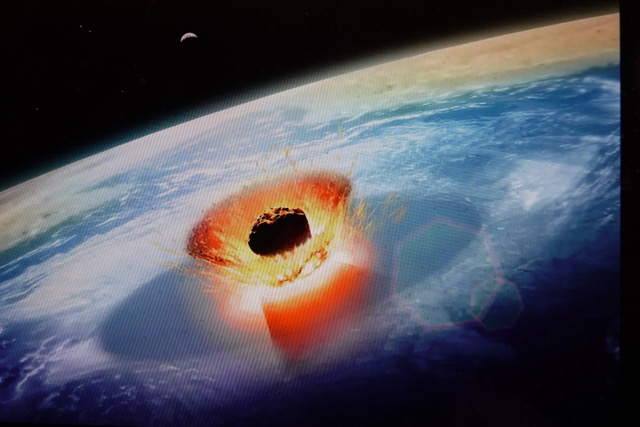
Might our home planet feel free to complain a bit, however, about that last extinction? The End Cretaceous moment, that came totally out of the blue – though out of the inky blackness of space is more like it – in the form of a six mile wide bit of space rock that landed with a mighty thud on what is now the Yucatan peninsula? Ouch! Holy worlds in collision all over again! Goodbye dinosaurs! So long, T. rex and the rest of your kind! Not to mention ammonites, mosasaurs, plesiosaurs, and pterosaurs, creatures mostly forgotten by everyone but evolutionary biologists. No adoration by generations of toddlers for them, or any Jurassic Park movie epic, though their passing was no less significant,

If it’s any consolation, all those species had a good run – 180 million years, by some estimates, not too shabby. Maybe that provided consolation for poor terra, who hadn’t planned on any of it happening, not this time around. Would other planets report similar rude indignities? Would they lament the loss of species they’d really come to appreciate?
All we know is terra kept spinning along, taking it all in stride and working with what was left, which happened to be a good half of species that survived all the changes. Mammals, fish, insects, trees and flowers and grasses and the whole of modern life as we know it slowly evolved, with the usual pattern of evolutionary winners and losers. Sixty six million years, from then up to the present day, is a lot of time, even though it’s a blink of eye from the four billion year perspective. It all sort of rolled along smoothly, up until about four million years ago when Australopithecus evolved into being, in Africa, the first of the line that would lead, by hook and crook, to the modern humans we call Homo sapiens.

Did the planet take note? Was there a “hmmm, these Australopithecus creatures seem a bit different” moment? Maybe not. A whole lot more time passed before the perfected, so to speak, Homo sapiens edition showed up, a mere 300 thousand years ago. In the planet’s grand scheme of things, this was basically only yesterday. As a species, H.sapiens were damn clever, superbly capable of surviving and expanding their numbers, though the humble beginnings phase lasted quite awhile. It took another 250 000 years for them to outgrow their home continent, but after that things moved along rather quickly, and look out!
Their facility for hunting and killing meant the extinction in fairly short order of all the larger mammals, the wooly mammoths and such. The earth was in the final stages of its most recent glacial period, the one we call the Ice Age, and the pattern of human survival followed a time-tested formula, subsisting on plants and animals, following our omnivorous proclivities. We hunted and we gathered, living in small groups for a good forty thousand years, until the planet warmed up big time about ten thousand years ago – the arrival of the so-called holocene era – and everything changed.
In a nutshell, we got organized like no species before, developing agriculture and living in large groups, expanding our numbers at a dizzying rate, spreading ourselves to all distant corners of the earth. It took about 7000 years for this enterprise to achieve its modern form – the arrival of so-called modern civilization – with the first large political state, Egypt’s First Dynasty under King Narmer, showing up around 3000 BC.

What followed is all too familiar. Call it the great March of Civilization, or Progress, or whatever. King Narmer got the ball rolling, but soon enough over the next few thousand years the eastern Mediterranean was blessed and/or cursed with one Pharaoh after another, to be followed by the glory that was Greece and the grandeur that was Rome. Similar developments farther east saw the great Asian dynasties of China, the Han and the Tang and the Song, and in our own hemisphere the Mayans and the Incas and the Aztecs. They were relative latecomers to join the parade, but certainly left as grandiose a legacy as any, before being subsumed by conquerors from Spain. All in all a story of winners and losers, the free and the enslaved, the rich and the poor and the powerful and the weak, where violence prevailed, winner take all, which included the right to tell the tale we know as “history.”
Today we revel in the impressive legacy of art, philosophy, and science bequeathed to us by those societies, but what drove it all – the dark nitty gritty of events that enriched the few to the cost of the many – all too often gets overlooked. To offer one example, Rome and its empire, which left us the writings of Pliny and Cicero, Virgil and Ovid, the glorious ruins of the colosseum and temples and grand country estates, was at war about 90% of the duration of its existence. One result of this was the largest slave system in human history, 100 to 200 million souls reduced to the level of mere property. The Romans did not invent this system, which goes back at least to the Code of Hammurabi in 1750 BC, a document long admired as the first to make the case for fairness, and respect for the rule of law. Fairness for whom? one might ask.

Once the ball got rolling, the March of Civilization was never about to stop, and it continues all around you at this very moment, down the Grand Avenue of History. It is quite possible you live a few streets off the Avenue somewhere, and only hear the drumming off in the distance, sometimes louder sometimes fainter, echoes of a world that is not quite yours. Nor can you ignore it completely, for at some point you outgrew your innocence of that other world, the one of history. This can happen by way of education, or the media, or the grapevine, or all three. Once discovered, its presence will be with you forever, lurking at the edge of your consciousness when it’s not staring you in the face.
It’s even possible you’ve personally met one or more of its victims along the way, or that you’re even one yourself, and wasn’t it great to escape that war zone? that dictatorship? that drought and famine?

The recent pandemic gave everyone a taste of what it’s like to get caught in the sweep of history, for better and for worse. But now, just a few years later, the experience has become something most of us survived and have shrugged off, none the worse for wear. As a consequence we might pay more attention these days to news of the latest epidemic filtering in from the world out there, ebola or hantavirus or whatever, but for now covid stands apart for hurtling into everyone’s life from wherever the hell it came from (the jury’s still out on that one), so rudely unexpected. Aren’t epidemics supposed to happen someplace else to somebody else, far away? That’s how it always worked in your world. Until it didn’t.
Worlds in collision! Two different worlds, yet one and the same, and both of them yours. You and all of us face the task of reconciling the two as best we can. No two of us do it in quite the same way, and over the course of a lifetime strategies can change. Who knows? You might choose at some point to plunge headlong yourself into that other world, the one of history, to do some brave and difficult or very risky thing. Such people we call heroes. Hero or not, if you’ve been conscious in leading what you know is a good and proper life, have strived to do the right thing enough of the time, you’ve a right to be a hero in your own mind. Really, you do!
When all is said and done, don’t the daily heroics of your life serve worthily as the greatest of distractions? Isn’t your personal story – mundane and dramatic, comic and even sometimes tragic and difficult by turns – in the end a kind of sanctuary, much more comprehensible and endurable than all that scary and unpleasant noise forever blasting at you from the March of History? The march in which you are likely not a soldier, or even in the marching band, but more of a bystander? On the other hand, if you hesitate to consider what passes in your daily life as “heroic,” you might wince or even be insulted by the thought that it is all mere “distraction.” Fair enough.
Consider it this way: what if it all comes down to the existence of two separate worlds of distraction, each endlessly vying for your precious attention? Each in its own orbit, spinning around and about your consciousness, except for those occasional jarring moments when those orbits cross, as they did with the pandemic. And what do we call such moments, class? (hint: it begins with ‘worlds” and ends in “collision” and if you haven’t been paying attention, that’s okay, it really is).

By no means does it take a pandemic for this to happen. Take the New England winter, for instance. The season of stark frigid beauty, when the landscape transforms into something totally distinct from the warmer months of the year. When the cold gets so acute that there are consequences if you venture forth unprepared, consequences no other season delivers with such power. Get it wrong and you’ll suffer, or could even die if you underestimate winter’s trickery, whether by way of snow or ice or cold in and of itself. The most distracting season of all, in many ways.
Except for the fact that the March of History is messing with these time-honored circumstances, as the engines of progress heat the atmosphere – you know this story – and local winters become less snowy, more icy (go figure), and essentially less distracting. Worlds in collision! Is the planet at least a little annoyed that a single species is messing with its time-tested ways of regulating the atmosphere? Talk about a bunch of upstarts! Gaia may yet have a few tricks up her sleeve in this regard. As in, it’s not exactly trending warmer, so much as crazier.

Case in point: after a string of warmer, near snowless, unwintry winters, this past November initiated countless weeks that were, in a word, cold. Combine this with the general atmosphere’s higher moisture content and what we got was snow, snow, and more snow, blasting like something from out of the past. As distractions go, nothing beats a one or two foot snowfall to keep the mind and body busy, moving it around and out of the way. This is especially true in the case of freeing one’s car, plowed in by the city with a sturdy wall of snow, ice, and lots of sand, the conglomerate from hell.

Chipping away at that wall brought Anna Karenina to mind, your latest read, and is there anything more distracting from the troubles of this world than a fat classic Russian novel? The book contains a wonderful scene whereby Levin, the nobleman with romantic notions about the peasants working on his farm, joins them, to their great surprise, to scythe away a ridiculous amount of pasture grass on a long summer’s day. It amounts to hours in the heat, Levin’s joy and pain and fatigue masterfully described by Leo Tolstoy, who in real life was known to swing a mean scythe in his later back-to-the-land years of spiritual awakening.

Okay, so working those snowstorms with a wheelbarrow in the 20º weather and a nasty wind chill wasn’t quite the same. But the focus required, the physical demands and final thrill of accomplishment were all there, and totally of the moment. A related project over the next few days – clearing the nearby sidewalks of those irresponsible homeowners who’d done a half-assed job, or none at all – delivered the same thrills, and felt heroic in the bargain, neighbors you’d never know thankful for a cleared sidewalk that wasn’t there before. It sucks to stroll along on cleared sidewalks and then hit a stretch of deep snow, uneven and slippery underneath.

In a similar distractive vein, the bird feeder in the back yard has long been a feature of the season and the inspiration for any number of ravinginbeantown postings (a catalogue of this writer’s personal distractions), for good reason. A source of beauty, unexpected surprises and occasional drama, all of it in endless flux as we roll through November and on to the end of April. Ours may lack some of the special thrills found at feeders in the forested suburbs, but hey, nothing beats the entertainment value of a squirrel, or its ability to annoy.


But it’s the birds who are the feature attraction, genuinely beautiful and a pleasure to observe. Aesthetics, above all, are what generate profits for the feeder industrial complex, the cardinals and bluebirds, goldfinches and hummingbirds and flashy species of similar ilk that populate the catalogs and star at the feeder-cam websites. Everybody loves a pretty bird, their irresistible appeal found somewhere deep in the human genome. Is not the beauty of nature the most powerful distraction of all, for a suffering humanity beaten down by the downsides of the March of History?

The long term observer of doings at the feeder might, however, also notice something else at work, as in the social dynamics that prevail back there through the course of a season. The key players have long been the house sparrows, year round survivors whose true home turf is the city. House sparrows possess a subtle beauty that bird lovers obsessed with flash and color will tend to overlook, and their numbers make them decidedly less special, in a way. They nest in nooks and crannies to be found in houses up and down the street, including two stellar locations on both sides of our front porch at #39. In a word, they’re prolific, producing several broods a summer. Come winter a tidal wave of brown covers the feeder, leaving other species to grab an opening when they can.

The other dominant species has long been the mourning doves, bigger birds who can easily push the sparrows out of the way when necessary. Mourning doves are genuinely beautiful, project an almost peaceful vibe that is nothing like the frenzy that prevails with the sparrows. A dove will often just sit motionless for the longest time, contemplating life as only a dove sees it.

Over the years it’s been doves and sparrows, sparrows and doves, with other species flitting in and out as they will. Everybody gets a shot at the feeding trough eventually, an ad hoc social order that leaves nobody out, if they’re patient and persistent. One other disruptor-species is the grackles in late winter or early spring, who show up all at once and take over for a day or two, an invading horde not to be reckoned with except by the occasional squirrel who shall not be messed with.


A more or less harmonious society, the order of nature something apart from the unbalanced winner-take-all ethos of the March of History. Or it was until the pigeons showed up, just a year ago, with a vengeance. Swarming like so many feathered locusts to the near-exclusion of everybody else, unrelenting until most seed was gone. A totally dominant elite species in this tiny universe, that had seen nothing like it up to now. All too reminiscent of – worlds in collision! – how it all goes down in the unfortunate world out there.

Go ahead. Tell me the comparison is all too ridiculous. Hey, come by some time next winter and experience the whole grotesque spectacle for yourself, and thus sobered we’ll reflect together upon what it all means.

Sitting down with Gaia for drinks at some out of the way intergalactic dive bar, would it be possible to get into a spirited conversation about human civilization and the March of History, and how it might have turned out differently? Say, in a way whereby H.sapiens would’ve eased a bit more seamlessly into how things are done here on terra, the more humble species’ behavior time-tested by the long history that preceded our arrival. Some simple adjustments that might’ve kept us from botching things so clumsily so as to generate another mass extinction, as is happening now? One would think Gaia is at least slightly annoyed at that development.
To keep things lively, we could ask her if she’s read a recent book – Goliath’s Curse: the History and Future of Societal Collapse – for a sentient planet would surely be a reader, as well. Why that book in particular? Because it makes the point that for a good 300 000 years, our peculiar outlier-of-a-species wasn’t that bad a fit. Sure, we killed pretty efficiently, but our numbers were limited and not growing all that fast. It was the Ice Age, when all species eked out a tough existence. Then the planet warmed, no big deal, just another of the endless changes that had been going on since forever, or at least four billion years.
But that particular warming ten thousand years ago was a game changer. If you’re a fan of the March of History and a believer in “human progress,” then it was a good thing. If you are troubled by the violence and suffering and injustice that it all involved, you might consider that warming to be an incubator for the darkest of human ambitions. Would our sentient planet have an opinion, here? Or could it not care less that H. sapiens arrived with some serious flaws that could lead to its eventual doom?

Goliath’s Curse makes the case, based on a vast database of archaeological findings only recently made available, that for 290 000 years we lived well within our means, like all the other species with which we shared the planet. Also, incredibly, it seems we were profoundly egalitarian, averse to hierarchy and domination, and as a kicker, we weren’t especially violent towards one another, either. There were undoubtedly difficult individuals who’d aspire towards domination, even a murder or two within or between groups – shucks, that’s all part of our humanity no doubt about it – but nothing to indicate what was to follow, mass deaths and dominant hierarchies on a grand scale.
Would Gaia find this interesting? Provocative, perhaps? What about the other point the book makes, right there in the title, that speaks of societal collapse? Recorded human history tells the story of large scale hierarchies, Goliaths as the book calls them, of fearsome power and dominance, same as the giant warrior in the Bible story. And just as David unexpectedly brought Goliath down, even the most dominant empires of history have been fated to fail, sooner or later, winners evolving into losers who get replaced sooner or later by different winners, and so forth and so on.
There is much gloom and doom prevailing in the current human zeitgeist, so many possible pitfalls that could lead to societal collapse on a grand scale. Choose your poison: will it be nuclear holocaust or AI-generated chaos, or the certainty of global warming leading to the collapse of large scale agriculture, along with aquatic life in the oceans? Can we expect a subsequent panicked migration of people, from uninhabitable regions to livable places, where they will most assuredly not be wanted? There are scientific predictions and any number of dystopian fantasies ready to flesh this out for you, should you need some help. But don’t panic or despair just yet, as it’ll all take awhile.
Would Gaia see a possible silver lining, here? This upstart species finally getting its comeuppance, so to speak, turning out to be just another flash in the pan, like the multitude of species that went extinct before it? The author of Goliath’s Curse, Luke Kemp, is even cautiously optimistic about this. After the cataclysm, which may resemble dystopian predictions or turn out to be something else entirely, the survivors – and there will certainly be some number of these – will be forced to do some sort of radical reset.
And maybe, just maybe, those positive human qualities that seemed to prevail for the first 290 000 years of our history, will come to the fore once again. Something along these lines will be required if we’re not to disappear completely. We may not return to being hunter gatherers in the old school ways, but a simpler and less ambitious existence, with a much smaller population, is what might work, with memories of the March of History freshly seen as a cautionary tale.

However it works out, with our species or without it, Gaia will no doubt take it all in stride, as she has with all previous changes over several billion years. Comparing notes, would HD 173010 b and the other life-sustaining planets shrug it off, as well? Noting how they’ve all seen their share of species that didn’t fit their time-tested planetary scheme of things, and how eventually things sort themselves out one way or another? No use getting sentimental about it, either.
Maybe they’d wrap things up by getting philosophical in some cosmic way, sharing thoughts about how it’s a privilege just doing one’s part, sustaining life in this grand enormous universe where life is a rare and precious commodity no matter what form it assumes, or what circumstances surround it, or how long it is able to survive. Things then might even take a sober turn, when they consider how stars and planets don’t last forever, either. Sometimes they just smash into one another and disappear on the spot with no hard feelings, Worlds in Collision and all that.
