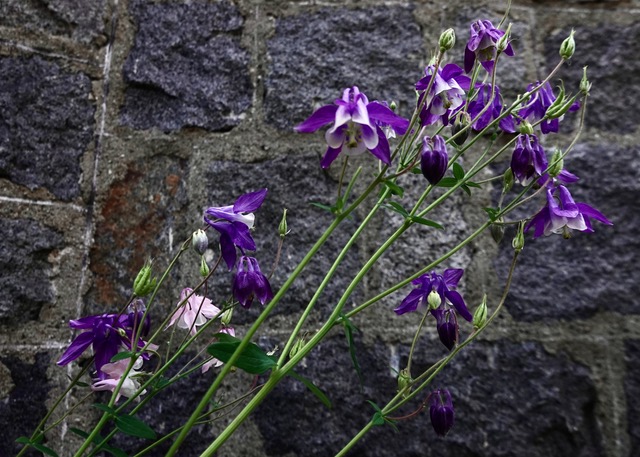
Has your life contained remarkable co-incidences? Are not all co-incidences remarkable, in one way or other? Is it possible life is full of co-incidences, some more remarkable than others, that pass unnoticed every single day, simply because we’re not paying close enough attention? Are you guilty of this oversight, and how would you even know? For now, just be aware that co-incidences can turn up at the most unlikely times in the least expected ways, and it pays to be ready and open to the possibility, or you might miss out on something that could be important. Really!
Case in point: this happens to be the time of year when the columbines are out, here in North America; some of them might be in bloom right around your house, as they currently are most visibly around ours. If botany is a total mystery to you, the columbine is a widespread perennial flower with distinctive smallish blossoms that cluster at the top of longish stems. It is a garden favorite. The co-incidence involves that flower and a big-deal Hollywood movie currently making the rounds, Pressure, which is yet another cinematic retelling of the WWII Normandy invasion of June 6, 1944, better known as D-Day. The film’s innovative angle happens to be the weather, of all things.

Critical and public response to the film has been mostly favorable – we are all fascinated by the weather, whatever the context, are we not? What is salient here is that a major figure in the story of D-Day was General Dwight David Eisenhower, head of Allied forces, played by Brendan Fraser this time around – previous actors who’ve played Eisenhower include Tom Selleck, Robert Duvall, and most incredibly Robin Williams, and that is not even a complete list. That Ike, as he was popularly known, is once again in the public eye by way of a movie, at the same moment as the columbines are blooming, strikes this writer as a striking and thought-provoking co-incidence, though for many the connection might be a bit obscure. You, of course, rolling your eyes in bewilderment at this point, might suggest the connection is very obscure, even a total mystery. So listen up.

Starting with the flower: Aquilegia loves shade and partial-shade, growing conditions we happen to have in spades here on Iffley Road, where they can turn up in any number of places, and often as not, do. The plants themselves appear a bit scraggly, and they’ve a reputation for being prolific self-seeders that spread readily, by way of wind and birds and whatever. These are qualities that pretty much define your typical weed, come to think of it, at which point we should remind ourselves that the term is extremely subjective, ill-defined, and all too often employed to judge, quite unfairly, lovely plants with many appealing qualities.
Aquilegia blossoms are distinctive and lovely, delicate and almost fragile-looking, with petals comprised of both a blade and a nectar spur. It’s those unique long trailing spurs that stand out, and have been likened to the talons of an eagle, hence the name: aquila is Latin for that mighty raptor. In Elizabethan times those spurs were taken to resemble the classic court jester’s cap, the columbine coming to represent folly and foolishness. The Bard of Avon was no doubt privy to this, and when poor Ophelia goes off the deep end in the fourth act of Hamlet, she offers the doomed King Claudius a bouquet of fennel and columbine, the symbolic message anything but upbeat.

Most important here, Aquilegia coerulea happens to be the state flower of Colorado, and don’t you dare uproot any if you happen to be within state lines! You might get fined or even deported, such is the fashion nowadays. One might wonder why a state would adopt a flower associated with folly and foolishness, but knowledgeable Coloradans will tell you that with A.coerulea it’s all about resilience and grace, positive qualities their plucky Colorado Blue demonstrates admirably, thriving (or at least surviving) in harsh, high-altitude Rocky Mountain places. Interpreting the symbology of flowers is anything but straightforward, or so it seems.
There’s even a town in Colorado named after the flower, which has a high school named after the town named after the flower, and in a cruel twist of fate far too many people nowadays, upon hearing the word “columbine” will have nary a thought about flowers but will shudder in horror over memories of the infamous shooting at Columbine High School, back in 1999. Such a shame. No flower deserves to have its reputation so horribly and unfairly besmirched, but history and memory and tragedy are powerful things, and here we are. It is also likely that many who recall the tragedy don’t even know that there is a flower by that name, a bloom of great and delicate beauty that is even mentioned in Shakespeare. This is an even bigger shame, a crying shame, as my mother might have said..

The Columbine High School massacre was a tragic moment in history, a day when 13 students were killed. D-Day was also tragic, but on the epic scale that is unique to wartime. The Columbine event was especially tragic, in part because it was so senseless. The tragedy of D-Day was that more than ten thousand died that day, in a war that ultimately killed millions. The glory of D-Day is that it was a moment when history turned a corner that would lead to the eventual end of the killing, a year later. There were no heroes at Columbine; there were countless heroes on D-Day, many of their stories forever unknown to history.
Even though he didn’t exactly put his life on the line that day, General Dwight Eisenhower played a heroic role as the guy in charge who was crucial in pulling the whole thing off. For him, what happened on D-Day is just one chapter in a story that made him one of the best known figures of the 20th century. I was aware of Ike because he was the President when I was still a young child, and my first memory of him, before I knew any of his grand story, gets us to the crux of the co-incidence in question. If you’ve already figured it out, take pride in being a true student of the obscure, which isn’t to say obscure means unimportant, as we shall see.

Ike was the President when I was a little kid, even though my parents had both voted for Adlai Stevenson in 1952 and 1956, back when they were still good Roosevelt Democrats. Or so goes the family story. It seems many Americans “liked Ike” a whole lot more than my parents, and he got voted in both times. Shucks, everybody liked Ike, at least a little. He’d won the war! It was also no small matter that the American economy was booming like at no other time in history, not that any President ever has much to do with that, but President Eisenhower clearly was not messing with a good thing, to his credit.
The astute historical observer might ask at this point “What’s the deal with the nickname?” It turns out Dwight came from a family of seven boys, all of whom were called “Ike” as children, a derivative of the family name. In the end, Dwight was the only Eisenhower boy who chose to keep the nickname, right through his time at West Point and on into his glorious future. Maybe there’s something about “Dwight” that begs for an alternative. For example, Dwight Gooden, the famed NY Mets pitcher, was better known as “Doc”, and Dwight Evans, the great Red Sox career right fielder, was beloved by fans as “Dewey.” On the other hand, Dwight Yoakum, the country star, and the fictional Dwight Schrute on The Office have done much to keep the name in the public eye. Why Dwight Eisenhower, the famous general and US President, chose to keep his childhood nickname throughout adulthood is anybody’s guess, but for what it’s worth “I like Ike” is a catchy campaign-slogan-for-the-ages, and it alone probably gained him more than a few votes when it really mattered. This is no surprise, really, given the level of sophistication of much of the American electorate. What’s not to like about Ike?

At this point let us imagine an American living room in the 1950s, of a family of modest means. Overstuffed couch and armchair that don’t quite match, though they look comfortable enough, maybe hand-me-downs from somebody’s sister. A rug on the floor and a kid on the rug and of course a TV, in a big wooden cabinet that dwarfs the screen. The TV is tuned into this news report in fuzzy black and white, of the arrival of the President – President Eisenhower – somewhere in the world or other, DC or Philadelphia or Munich or Brussels, it doesn’t really matter. The kid is pretty young, five or six or seven at most, not paying close attention – it’s a news report, for God sakes, and what little kid pays attention to those? Which suggests there is probably an adult in the room, as well, otherwise the kid would long ago have switched it over to Howdy Doody or some such nonsense, and who can ever forget Buffalo Bob and Clarabelle and Princess Summerfall Winterspring?
But on this day it’s sorry, kid, today we’re watching President Eisenhower arriving somewhere because it’s important, and for reasons you wouldn’t understand. Which is no doubt true, but what matters here is that this particular Presidential arrival does not feature a Presidential limousine or a red carpet, or a Presidential shaking-of-hands with some head-of-state outside some government hall of power. Nope, in this particular bit of news footage, Dwight D. Eisenhower, the President of the United States, is arriving at an airport, by airplane, and not just any airplane but a Lockheed Constellation, which happens to be one of the most beautiful airliners in history, something the kid understands completely, even at his tender age.

Unsurprisingly, he’s gained this understanding by way of his Dad, a member of the Greatest Generation who had, in fact, served in the Air Force during the war just a few years before, hence his passion for flying machines that he has passed down to his son. So it’s no wonder that the image of a Connie (just like Ike, the Constellation had a nickname!) on that TV screen catches the kid’s eye, there on the tarmac of an airport somewhere in the world, and as it rolls to a stop, four propellers spinning in the sunlight, we hear the fateful words that will stay with the kid forever from this moment on, that go something like “here’s President Eisenhower, arriving at blah blah blah for the purpose of blah blah blah, on the Presidential Plane, THE COLUMBINE, blah blah and so on and so forth.” None of which matters, really, as it will all be forgotten by the kid in short order, everything except for the visual of the plane and its elegant and majestic name.
Another key element of this story was the kid’s total lack of curiosity about that name. To him, “Columbine” suggested something classical and timeless, a god or goddess or king or queen from antiquity, perhaps, that clearly held some special meaning for our President. The man had been schooled in the early 20th century, after all, back when learning Latin and Greek was a thing. Then there is the fact that the nation’s capital is the District of Columbia, which suggests some kind of obvious and direct connection. Nothing more to figure out here, folks!

Yes, our young man was very very wrong about all of this, and he was to remain confidently in the wrong until way too many years later. Maybe we shouldn’t be too hard on the fellow, for after all, who would ever expect a President of the United States, Commander-in-Chief and Leader of the Free World to name his official Presidential plane after a flower? A flower that was, in fact, painted in several places there on the fuselage, though it is possible the television image all those years ago had not made this very clear, if it was visible at all on that tiny screen. Which leads to the final mystery: why a flower, and why that one in particular? The answer is so elementary, my dear Watson, it’s almost silly, also heartwarming and beautiful: Ike loved his wife, Mamie. Mamie, whose home state, the place where she grew up and dearest to her heart, happened to be (you guessed it, didn’t you?) Colorado. Is there anything more to add, here?

One could reflect a moment on what it says about Dwight Eisenhower, career warrior and eventual Commander-in-Chief, who was not afraid to be openly sentimental when it came to the very public gesture of naming his official airplane. One could see this as a true outlier-gesture in this particular pubic realm. For one thing: isn’t the official plane of the President of the United States, the Chief Executive and Leader of the Free World, then and now and forever, known as Air Force One? As in We’re number One! Well no, as it turns out.
Take a close look at the picture from 1910: the plane is a Wright Flyer, back when Wright Flyers were one of the only airplane types in existence, period. The fellow on the right is Arch Hoxsey, the pilot. The fellow on the left should be familiar to any student of the history of the day, especially a student of American history, and by God if it isn’t Teddy Roosevelt! Who’d left the office of President just the year before this picture was taken, so no, he was not the first US President to fly in (or on, in this case) an airplane, if only by a technicality. Teddy was always the guy looking for the next adventure, which aviation certainly was in 1910.

Flying was so much of an adventure, in fact, that US Presidents were not exactly encouraged to give it a try for another three decades. Franklin Roosevelt finally rose to the occasion, so to speak, by flying to a conference in Morocco in 1943, the better to avoid U-boats lurking in the Atlantic down below. He was only to fly one more time, to Yalta in 1945, but this time on an official, bona fide Presidential plane, with the unofficial and somewhat unfortunate nickname Sacred Cow, due to all the special security measures that were installed aboard. Rather undignified, but hey, there was a war on, so stop snickering!


Harry Truman was the first to seriously get with the program and enter the modern air age, flying on the Sacred Cow regularly. He even moved on to his own updated shiny new plane in 1947, naming it The Independence in honor of his Missouri hometown. “Give ‘Em Hell” Harry took the very bold step of painting his plane to resemble an eagle, at least as far as this was possible, and you can decide for yourself how successfully this turned out. You can also snicker at this point, if so inclined, but be aware that this was shortly after the end of WWII, which had seen any number of cartoonishly decorated fighter and bomber planes, some of them quite wonderful in a ghoulish kind of way.


Which brings us back to Ike and the Columbine. President Eisenhower could’ve taken the path of least resistance and carried on with Harry’s cartoon eagle, which of course he didn’t. Was the motif just too silly? Did the man hate eagles? One could probe the depths of the major Ike biographies, of which there are at least three, but these days AI is perfect for ferreting out obscure (though terribly important!) info of this nature, and what we get is 1) Ike wanted and needed a more modern and capable plane, especially one with greater range and updated electronics, and 2) in the end, Eisenhower and Truman had a sort of falling out, aside from the fact that they were from opposing political parties. AI suggests Truman was furious that Ike had not defended General George Marshall from attacks by the notorious anti-Communist Joe McCarthy, but one suspects AI is being lazy here and that the full story is way more complicated. The truly curious will know where to find the juicy details, should they need them.


It also makes sense that Ike simply wanted a clean break from the previous administration, on all levels. In this vein, why not choose a new plane, one that not only was more modern with better specs, but which was simply more lovely to behold? And eschewing any Presidential pretension, naming it in a way that honored his wife? By way of a flower?
Eisenhower, the career military man who’d gloriously prevailed in wartime, knew he had nothing to fear about showing a softer side of himself in this way, even after assuming all the responsibility and authority of the Presidency of the US. It remains one of the more intriguing and unique things about him, a small detail of his story that belies the well known narrative.

One more thing: The Columbine, it turns out, was also the first Air Force One, which was to become the official and permanent name for all US Presidential airplanes, to this day. Only with Ike’s plane it was still unofficial, a name originally only used by the pilots and air traffic controllers. They began that practice after an incident occurred whereby the President’s plane got confused with a commercial airliner in the same airspace with the same call sign, Air Force 8610 and Eastern Airlines 8610, to be specific. After that it was Air Force One, no ifs, ands, or buts, and clear the decks when you know it’s coming.

Towards the end of his second term Eisenhower moved into the jet age with a Boeing 707, the first official Air Force One. It meant so long to the beautiful Connie, named after a flower that honored Mamie, his wife. One hopes she didn’t mind. An interesting aspect of this story is that Ike’s planes had always retained their military identity, no special paint job like Truman’s plane, and this was also true of his new jet. That all changed when John Kennedy replaced Ike as President in 1961. JFK wanted a distinctive new paint job for his plane, something flashy yet dignified and unmistakably presidential. He entrusted the task of getting this right to Raymond Loewy, the noted industrial designer (known as the father of streamlining, among other things) and his wife Jackie, of all people, though if Jackie was known for anything, it was for her exquisite good taste.

What the two delivered was a color scheme of white and two shades of blue over silver, with “United States of America” in a Caslon typeface, similar to that used for the first printed broadsides of the Declaration of Independence, back in the country’s beginning. Whether they hit a home run with this is very much in the eyes of the beholder, but this beholder will always have a special place in his usually unsentimental heart for the military airplane with flowers painted on the side, so unpresidential yet perfect, those particular flowers and that particular plane and best of all the story that they tell, reflective of a moment in history that at this point was a long time ago, when the world was so very different.
