Did people really once say that? Along with “go jump in the lake” and “take a hike” and “make like a tree and leave”? Did anybody ever make such a request to you, and what in heaven’s name were you doing to provoke them? A request that in its way is so much more polite and gentle than “scram!” or “beat it” or “get outta my face!”or in the coarsening vernacular of these troubled times, “fuck off!”, so brutal and ultimately rather pathetic.

All of these are what one might call dismissals of various sorts, and it’s possible you’ve never personally been dismissed in such a way. Or you were but you’ve forgotten, which might be a good thing. Dismissals such as these can have uses beyond the interpersonal, like for instance:
As for Darwin, he can take his theory of evolution and go fly a kite
which you must admit is a kinder and gentler way to refute The Origin of Species, as ridiculous as it might be to do this.

When it comes to “go fly a kite”, to take the directive literally would mean to retreat from the premises and head directly to some nearby open space and fly one’s kite, which presupposes one already has a kite on hand, which is assuming quite a lot. At one point kites could be found everywhere, in dime and toy and corner stores, costing no more than a dime, or at most a quarter. You also needed string, of course, and some basic skills to assemble the thing, which consisted of a few sticks and some tissue paper, as crude and fragile as can be. Oh, and maybe some rags for the “tail”, crucial for balance and stability.

And of course, there had to be some kind of wind. Preferably more than a zephyr (named after Zephyrus, the Greek god of the west wind), less than a gale, and above all constant, though wild variations in direction and velocity can make the whole experience more interesting and challenging, if you’re into that kind of thing. In the worst case this can lead to a crash and catastrophic loss; on the other hand it’s just a kite. On the other other hand, even worse than a capricious wind and a crash is to have no wind at all, or not enough. The one thing worse than losing is not even getting into the game.
Ah, but for those times when the wind is right: for all its kid stuff aspects, flying a kite can be a personal and meditative experience, a means for communing with one of the basic forces of nature, for those possessing a romantic imagination. Hanging on to that kite string, one senses directly the power of the wind and its many subtle moment-by-moment changes, same as what a bird must experience; it’s all about flight, and flight is a wonderful thing, as any bird can tell you.

As for the dark side of kite flying, this was brilliantly expressed by Charles M. Schulz, who’d evidently had some seriously traumatic experiences attempting it in his youth. Poor Charlie Brown! Showing up on the scene 75 years ago, poor Chuck has been analyzed to death over the years, along with all the Peanuts characters. If you’re a fan of the Meyers-Briggs® Personality Types, he’s an INFP (Introversion, Intuition, Feeling and Perceiving), a dreamer with a deep emotional landscape. When his visions of flight face defeat, either from capricious winds or to the fierce appetite of the kite-eating tree, he can’t handle the disappointment inherent in so much reality, to which he overreacts and ultimately gives up. Kite-flying is not for the weak of spirit.

A 2010 article in Psychology Today pegged Charlie Brown as the model neurotic, depressed, anxious and overly analytical in his approach to life. He perseverates endlessly about how to win the heart of the little red-haired girl but can never quite take action, endures betrayal after betrayal by Lucy in his attempts to kick the football, but his most spectacular and painful failure is focused on his kite. The message seems to be that someone so psychologically weighted down is simply incapable of flight of any kind, as simplistic as that may sound. To fly a kite is to possess a lightness of spirit, and a readiness to face any outcome, where success is never guaranteed.

It should come as no surprise that the lighter side of kite flying, where joy prevails almost to the point of inanity, comes to us by way of Walt Disney, in the final scene from Mary Poppins. George Banks, facing a failed career as a banker (for a truly dumb reason, but hey! it’s a children’s story!) and growing awareness of his shortcomings as a father, has a moment of existential insight about what truly matters in life. So what does George do next? He mends his children’s kites and they join the crowds down at their local London park, where everyone is most elegantly dressed and the winds are evidently perfect. Of course.

The moment is so powerful that everybody is inspired to sing what is evidently the kite flyer’s anthem, at least in England, Let’s Go Fly a Kite, a song that is so upbeat it would make poor Charlie Brown weep, were he ever to hear it.

Peanuts and Mary Poppins are both works of fiction, as is The Kite Runner, a novel based on a real-life cultural tradition long practiced in the wind-friendly neighborhoods of Kabul, Afghanistan, a long long way from London and Charlie Brown’s suburban American neighborhood in more ways than you can count. Kabul is as gritty and hardscrabble a place as it gets – this is back in the days of the Soviet-Afghan war and the arrival of the Taliban – where competitive kite-flying is all about literally cutting your neighboring fliers out of the sky with a sharp-edged line of glass-coated cotton. It’s a grand story of trust and betrayal, guilt and redemption, where flying kites becomes a means for love and bonding in a way the Banks children and the Peanuts crowd could never imagine in their wildest dreams.

Chances are some of this is familiar to you. Maybe you’re a true Peanuts fan, familiar with the strip’s long history and not just somebody who’s seen the TV specials or collected Snoopy paraphernalia. You remember Charlie Brown and that kite, a comic riff so darkly hilarious in its twisted way. You also loved that Mary Poppins, Julie Andrews and Dick Van Dyke and all those great songs. You made a point to share it with your own kids all those years later, and golly the ending was still truly heartwarming. The Kite Runner is a much more recent memory, and maybe you not only read the book but also saw the movie, and what an emotional roller-coaster that was!

So: at any moment in all that did your inner child, following the power of suggestion, gently whisper or fervently urge you to go fly a kite? And did you listen? Is it possible your inner child has few, if any, memories of kite-flying? Or that the ones you are able to conjure up are not exactly inspiring, perhaps even tinged with negativity, along the lines of poor pathetic Charlie Brown? What would it take to get anybody to go fly a kite nowadays?


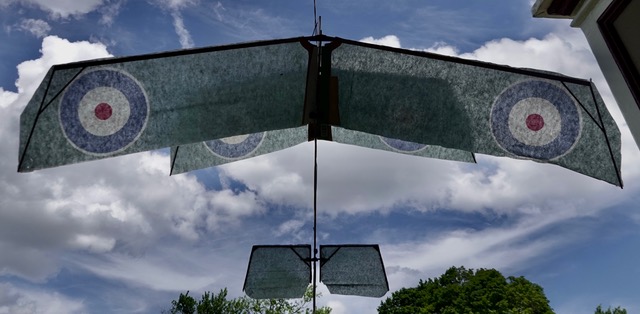
To offer one answer to such an odd question: how about clearing out a dusty top shelf in your basement while wiring up a new ceiling light, only to come across a curious-sized box, five inches wide and an inch deep and three feet long? Such an odd shape and size that it had sat up there, sight unseen, for God knows how long. There was no mystery as to what it contained: Squadron Kites Sopwith Camel BIG 4 ft. WINGSPAN! proclaimed the label on top, though how such an outsized thing could be made to fit in there was not entirely clear. As for its possible age, there was a copyright date on the instructions inside: 1972. This thing had been accumulating dust for a mighty long time.


Having no memory of obtaining this object only deepened the mystery (though it must be said that at this point, our basement could contain any number of such objects, waiting to be rediscovered). The theory that it somehow belonged to some unknown person who’d lived in our house and left it there held no water, as somebody (Craig A. Stratton, of Stratton Engineering?) had written our names on the instruction sheet, and why would they have bothered to do that? The very large instruction sheet, water stained in places, was in itself something to behold: written in five languages, with full size plans for the various structural components and a number of drawings that ran from careful and detailed to charmingly crude. To top it off, somebody (Craig A. Stratton, of Stratton Engineering? Me??) had haphazardly crossed out most – but not all – of the non-English sections of the text with a Sharpie. The overall visual effect suggested heavily redacted secret plans left out in the rain by some absent-minded spy.


Dumping out the contents of the box revealed how a biggish kite could fit inside: aside from folded-up instructions and colorful paper covering material, it was just a bunch of sticks, of various dimensions, most of them three feet long, hence the oddly-shaped container. This kite was meant to be assembled totally from scratch, using those sticks shortened to various lengths. What could be more methodical, time consuming, and totally fun, in a meditative way? All that was needed was some glue, and a hobby knife, and some scissors. And a rather large workspace to accommodate the full-sized plans for the fuselage and wings and such. And some wax paper, and a surface into which one could stick pins or tacks to hold various assemblies in place while the glue dried. And a lot of patience.


Along with the sticks there was a stiff manila sheet, to be cut into various odd shapes and glue to the joints for added strength, which were the gussets. When’s the last time you saw a gusset? This thing had been engineered. While most model planes designed for flight use balsa, the sticks provided for this kite were spruce, which happened to be the wood of choice for real planes back in the early days of aviation. The Wright brothers used it, not only for their famous heavier-than-air machine, but also for the various kites they put together to test out their ideas. It was easy to imagine Wilbur and Orville smiling down from above, watching someone else take humble steps towards flight over a hundred years after their epic achievement on the sands at Kitty Hawk NC.


And it is no small coincidence that this writer had once worked as a bicycle mechanic. Where history differs at this point is that this writer has long been an avid bike rider, as well, while there doesn’t seem to be much evidence the Wright boys were ever all that passionate about two-wheelers, beyond the business aspects and the joys of tinkering with machinery. They were serious men of the twentieth century, whereas this writer is known to long for the simple joys of the nineteenth, with all the Luddite implications.

There are other differences that are more telling. For one thing, the Wrights were smart in covering the frame of their craft with unbleached, untreated 100% cotton muslin, a high thread-count material whose brand name was Pride of the West, and what could be more grand, or durable? Craig A. Stratton of Stratton Engineering, on the other hand, provides the kite-builder with colored tissue paper, the flimsiest thing imaginable. Transporting and handling his finished product has already resulted in several tears, as an inadvertent finger will go right through it. Of course, this is the same stuff those kites of childhood used, and thinking about it they were truly throwaway items in some ways. Hey, waddaya expect for a quarter?


One notes that modern kites, of even the simplest and cheapest variety (which today is about ten bucks, not bad considering inflation), use ripstop nylon, the material of choice for any number of reasons, but above all for its durability. They also employ fiberglass for the frame structure, lightweight and essentially unbreakable, which of course lacks the romance of working with spruce. Thinking about it, the Stratton kite gives you tissue paper for the nostalgia angle and spruce for the romance of it; the sum total is anything but a modern flying toy, but doesn’t that just make it more special, form transcending function?


Which gets us to the final phase of this endeavor, whereby this flimsy tissue and spruce creation takes to the skies. Flight is, after all, any kite’s raison d’etre, the fulfillment of its destiny and all that. Thus far with this kite, unfortunately, it’s been more Charlie Brown than Mary Poppins or The Kite Runner. At least nobody’s cut this kite out of the sky with a glass-infused line. Summer is not Boston’s windiest season, though truth be told this becomes most noticeable when one longs to fly a kite that evidently needs more than a light wind to ensure success.

This has been the lesson learned from three attempts. The first attempt held tremendous potential: an inaugural flight at the nearby Franklin Park Kite Festival, which has been staged yearly just up the hill from our house since forever. Talk about a perfect occasion! Ah, but arriving at the event’s location, the hallowed Playstead meadow, part of the original Frederick Law Olmsted plan from the 1880s (back then the site of badminton and lawn tennis, nowadays more baseball and cricket), there were maybe 100 kids and an equal number of kites, with but one having made it successfully aloft. Lots of running around, lots of helpful advice being shouted out by hopeful parents, lots of kites totally earthbound.

What was the secret of that lone flyer? A kite designed for light winds, no doubt, and someone who clearly knew what they were doing. And maybe a bit of luck, one freak gust that swept that baby up there, where it hovered as a symbol that anything was possible on this fine spring day. Don’t give up, kids! Unfortunately, it appeared that nearly everybody had, though nothing like a Charlie Brown style meltdown was evident anywhere, thank goodness. And the weather was perfect, if you weren’t trying to fly a kite.

Another shot at the Playstead a few weeks later, on a day that held much promise (it was genuinely windy, at least on our westward-facing porch), yielded the same result, and the realization that Olmsted’s hallowed design of the Playstead actually put it in a kind of bowl, with trees atop a rise on the western edge. Most amazingly, Craig A. Stratton put an illustration on his instruction sheet that could’ve used the Playstead as a model, offering advice on how to overcome wind-blocking obstacles, which unfortunately required some amount of running, great if you’re young, more problematic if youth was a long time ago, as it was for us.

This led to some thinking, analytical and strategic and maybe even a bit tactical, in ways only a kite flier would understand. Best conditions at the Playstead are clearly when the wind is from the east, preferably somewhere between gusty and gale-force, or at least moderate to high.
It is possible Frederick Law Olmsted included this advice in his 1884 General Plan for Franklin Park, in a footnote that has been lost to history? There is no evidence in any of the various biographies of the man that kite flying was one of his passions, which doesn’t preclude the possibility. You can bet that his kite, if he had one, was made of tissue and spruce.

More deep thinking on these matters led back to the Wright Brothers and their particular flying site of choice. History tells us the boys’ bike shop was in Dayton, Ohio, but when they got serious about the flying thing, they set up shop on the oceanside dunes of Kitty Hawk, North Carolina, as a place that had the most promising winds. Of course! Should it come as a surprise that the biggest kite supply outfit in the US happens to be Kitty Hawk Kites, based at that same windy location?

Thinking extremely deeply suggests that the only wind-friendly environment that might surpass an oceanside setting would be somewhere on the prairies, a place notable for its winds, so strong and relentless that they were known to drive some of the settlers stark raving mad, back in the pioneer days. Ask any fan of Laura Ingalls Wilder about this and you could get an earful. While you’re listening, you might ask them if there’s anything in those Little House on the Prairie books where she mentions kites.

In Boston it’s a long way to the nearest prairie but of course the ocean is right at hand, and would you believe that the day we tried an oceanside kite launch there was no wind? Totally becalmed! Nada! Was it time for an epic Charlie-Brown-style tantrum? A moment of total despair? Or better, maybe a philosophical inquiry in the manner of Linus, who is, after all, the neighborhood kid in Peanuts who is weirdly, cerebrally, adult, except for his thumb-sucking habit and need for that security blanket.
“Hey” he might say, “it’s just a kite, Charlie Brown” and
”tomorrow’s another day,” and “there’s always a good wind
somewhere, you’ve just gotta be ready when one comes
your way.”
That Linus, such a fount of wisdom and good sense, kind of like Mary Poppins herself, a spoonful of sugar and all that. You never see him flying a kite in the comic strip, but rest assured he’d take it on with the right attitude, manage the failures and celebrate the successes. Or maybe not.

Maybe it is telling that he never makes an attempt in the first place. For all his thoughtfulness and positivity, Linus in the end is a bit insecure – the kid is really attached to that blanket, for one thing, and with kite flying there are inherent risks; failure, if you want to call it that, can take on many forms, as Charlie Brown shows us, and in his case, there’s hell to pay. Kite flying calls for what mundanely can be described as a mature attitude; an adventurous spirit says it a lot better. Success can be thwarted in so many ways, though this may be less true for kite fliers living by the ocean or on the prairies or in windy Kabul, where they’ve spiced up the experience in their own way.

For the rest of us it’s more complicated, a bit more of a challenge and therein maybe a richer experience. Okay, you can laugh. And what if one’s kite is fragile, with no small effort behind its creation? Hey, it’s just a kite! Failure and loss can be terrible things in life, but there’s definitely such a thing as kid stuff loss, as well as kid stuff success, and keeping things in perspective. If you care to test this out, maybe you should go fly a kite, and see what you get. You may be surprised.
