As you should know by now, we H.sapiens have deep aggie roots. This includes you. In the very beginning we hunted and gathered, which is the polite way of saying our humble ancestors scrounged nuts and berries and squirrels and even bugs and whatever else they could from the planet to survive, but learning to cultivate from the land was the big game-changer, for better or worse. Growing grain and whatever for the multitudes is the practice that eventually gifted us steady population growth and large social structures and stratified classes, cities and nation-states and armies and countless other catastrophes, as well, and it was all probably inevitable. Of course there’s a good side to this somewhere, especially if one believes in grand notions of “progress.”
If you dig deeply enough into your ancestral past, chances are good you’ll find some kind of agricultural operation somewhere. In modern times, the “family farm” has become part of the American cultural mythos, and such a thing still exists here and there, though capitalism has been kind of a game-changer in that particular realm. Ours is the country where the government passes an annual Farm Bill that gives huge subsidies to the big corporate growers of things like corn that is made into ethanol, and soybeans that feed animals for the meat industry, and cotton that requires huge quantities of water and is, by the way, inedible. Many a family farm now survives by featuring pick-your-own crops, as well as a petting zoo and gift shop where you can buy homemade jam and mugs with pictures of Rosita and Marge, the alpaca and miniature pony that your kids just stroked.

Thankfully there’s a bit of pushback against corporate agriculture’s dominance of late, with the growth of farmers’ markets and awareness of the value of growing locally. As the bumper sticker says “No Farms No Food,” and would you believe that many school children (and more than a few adults) have no idea how what they call “food” ends up on the supermarket shelf, at least what happens before it arrives at a factory or a warehouse? Looking at some of the product on display at the supermarket, don’t you yourself sometimes wonder whether its origins bear any connection to the land, or photosynthesis, or any sort of “natural” process, at all? Is the cereal aisle not a place of wonder and terror and bewilderment? Which doesn’t mean some of what’s in those boxes might not taste great, even though it may not qualify as “food” in any meaningful way. It helps if you have a sweet tooth.

One needn’t grow up on a farm to know the nitty-gritty of growing food firsthand, as the backyard garden is certainly a farming operation of sorts, albeit a humble one. Many of those still alive who grew up during The Great Depression have memories of family gardens, along with the Victory Gardens of WWII, and I was surprised at how many of the elderly Black ladies I visited as a social worker deeply missed the gardens of their youth, as their families coped with poverty in the deep South, following a tradition that went back generations. Many longed for fresh okra.

In the present day, community gardens offer urban dwellers the opportunity to get real with the growing process, and our own multi-decade experience at the Paul Gore Beecher Street operation (chronicled in several other posts) has been a key element in our lives, with value way beyond savoring fresh tomatoes and chard and so much more delightful foodstuff you wouldn’t believe. This writer humbly admits to being a bit player on this stage, a mere laborer who loves occasionally weeding and harvesting ripe product, while his wife has taken on a starring role, finding PGBS to be a source of not just food and community connection but also joy and sanity, though of course the workload can get ridiculous during the growing season. Gardening has been touted as an effective means of enhancing one’s mental health, but the appeal is not universal, as not everyone finds sanity or serenity by messing with plants and dirt. For some number of people, those aggie roots may have atrophied entirely, and DIY agriculture holds no appeal whatsoever.

It is thus fabulously fortunate that there’s another route to follow when seeking deep connection with one’s ancient food-cultivation heritage, and in this regard the humble child’s “farm play set” speaks volumes. Most unbelievably this classic seems to have stood the test of time, though to a modern child, a collection that includes a barn and a tractor, along with a cow and a horse and a pig and several tiny chickens, might seem no more real than their Star Wars Action play set. Luke Skywalker? Farmer MacGregor? All the same!

Whether your kid – or you, for that matter – spend hours of imaginary playtime accessing your aggie roots is one thing. What is more curious and germane to this meandering discussion is how that humble and charming collection of miniatures is about livestock, for the most part. You may get a tractor with a plow and a harrow and a cultivator, but the set does not include a field of plastic wheat or corn, leaving that all to the imagination. The literal-minded child sees only the cute little animals, and might miss an important point about what it’s all about. Do they spend playtime giving them all rides on the tractor? The point is, our aggie roots are about fauna as much as flora, and one needn’t have a garden to be part of the grand tradition.

On a simple household level in more rural areas, one might see rabbit hutches and chicken coops in people’s backyards, where the work involved is akin to working a garden. One gets dirty and sweaty all the same, though with creatures it’s about buying food and setting it out, cleaning out living quarters (smelly and a bit gross in ways the gardener never encounters) and doing what is necessary to keep one’s animals alive and healthy. There is a movement to zone urban and suburban areas to allow such things, which is now the case in 60 towns in the Commonwealth but not yet in Boston, where we struggle enough with wild turkeys and geese roaming the streets and parks.

So this particular urban dweller, joining legions of others, has chosen to satisfy his deep yearnings for agricultural expression by means of feeding livestock, as represented by wild birds, given that the domestic variety remains off-limits. The multitudes currently running backyard bird-feeding operations (BYFOs, not to be confused with those miserable CAFOs) have generated an entire industry to meet their needs, a kind of bird-feeding industrial complex, if you will. What drives it is a love of nature, of course, and folks’ desire to witness avian glory up close and personal, and for some it is another means of getting known on social media, of which there are so many nowadays.

With a little reflection, might they also realize how some of the joy arises from being part of the long and honorable human tradition of cultivation? Perhaps they’re not cultivating sustenance for human consumption, which is of course the whole point of agriculture, but what about food for the soul, which comes from the joy of connecting with one’s fine feathered friends? The fact is, running a BYFO involves work, which may lie at the heart of the matter when it comes to aggie roots. This aspect of those roots runs mighty deep, in a tradition that goes all the way back to the Garden of Eden, with Adam getting cast out to toil by the sweat of his brow, and can it get any grander than that? Did they even need bird feeders in the Garden of Eden?

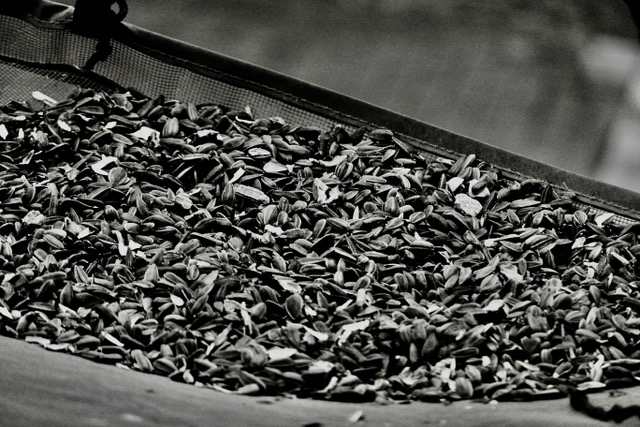
Of course, there are BYFOs and there are BYFOs. For many, a few small feeders, or maybe just one, is often the norm. Buy a five or ten pound bag of sunflower seed, or maybe just the cheap stuff (usually labeled as “mix” of some sort), hang your feeder of choice from a bush or tree, and watch what happens from your kitchen. Chances are you’ll get some takers, at least until the thing is empty and you bother to refill it. Some BYFO operators are very casual about this, or even lax, or by some measures irresponsible, which might be an unfair accusation because the fact is, the birdies in your yard don’t need your handouts to survive. Not to say they don’t love the offer of an easy meal, as who doesn’t, but when you cease to offer one, God’s plan will take care of them. Or it always has, at least up until now.

The tentacles of the feeder-industrial complex are everywhere, at most big box stores and your local hardware store and such, but their greatest presence is at outlets that specialize in this mania. One of the biggest of these is Duncraft, and a perusal of that feeding behemoth’s catalogue offers a vision of sorts, of the marvels that await one who goes to the trouble of using their product, which includes birdseed platforms that run from functional to silly, to what approaches science fiction. A marvelous vision it truly is, as the pictures show, with a nice assortment of America’s typical backyard feathered denizens, goldfinches and chickadees and titmice, cardinals (in the snow, natch), a nuthatch and a red-bellied woodpecker. It’s an honest vision, as well, as all these birds are regulars, more or less, at 39 Iffley’s BYFO. Things get a bit exotic by Iffley Rd standards with Duncraft’s promise of bluebirds and pileated and red-headed woodpeckers, but it’s a fact that BYFOs are more a suburban phenomenon than part of the city landscape, something to be explored further in part 2.


In fact, the “vision” that is realized at this writer’s BYFO differs in a number of ways from the Duncraft version, which wisely omits mention of the work involved. Maybe the catalogue people figure this is self evident, which in some ways it probably is, especially given that most of Duncraft’s offerings are small and simple affairs, requiring minimal work, for the most part. One mounts the chosen feeder (many options are offered to effect this, some of them a bit involved), buys the seed, either from the catalogue or locally, and keeps the feeder filled at one’s convenience – or out of guilt, as there’s something about an empty feeder that implies avian disappointment and human irresponsibility, or maybe this writer is speaking for himself. The rest is pure visual pleasure.


Personal experience suggests there might be more to this story. Let us begin with one man’s feeder-mounting saga. We can start with the curious appearance of a common clothesline pulley high up the trunk of one of the backyard maples here at 39. You think it was easy getting that thing up there? But such a great idea! For then one can affix another one on one’s second floor back porch and voila! one has the means to run a line across the yard, facilitating the hanging of clothes, bedsheets, you name it, high in the air, part of a long urban tradition. Even better, in winter when clothes-drying is relegated to indoor spaces, that line offers itself as a terrific opportunity to hang a bird feeder, way up there out in the open, as any wild bird would no doubt greatly prefer. Which is exactly what played out at 39 Iffley Rd with much success, more or less, though the line sagged quite a bit under load, at times. Textiles weigh nothing, compared to a feeder loaded with seed and covered with hungry birds.

Fast forward a couple of years, when one day the line (and the feeder) sort of disappeared. Not to worry, the line must have finally rotted away after so much exposure to sunlight and weather! The feeder, a bit dented now, was still quite usable after a bit of reshaping. The line, which must have been cotton, was replaced by a nylon version, essentially plastic and sure to withstand any rigors it might face. Well not quite. That line came down in about a week. Talk about shocking! Talk about unexpected rigors, like the threat of a squirrel too smart for its own good (or maybe just smart enough, which is all that mattered). This catastrophe should not have been entirely unexpected, as one resourceful (or very hungry) squirrel had been amusingly and impressively shinnying out on that line since installation, munching for awhile, then shinnying back. There’s no photographic evidence of this, which is a bit of a shame, but there are endless videos available of squirrels outwitting BYFO operators in the most magnificent ways. In this case, the clever creature had finally come up with the master stroke of chewing through the line, making all of the seed conveniently available down there on the ground. So smart!


The “Squirrel Problem” is well known to the BYFO world, and many of Duncraft’s offerings claim to employ effective means of frustrating Rodentia sciuridae so as to save more seed for the birdies. Birds are beautiful, which admittedly is the whole point here, but squirrels sometimes are just fun, in a way that birds can’t match, and can’t we all just co-exist? It’s we homo sapiens who are prone to being adversarial, hence the notion of a “problem,” though it’s also true that enough squirrel action can keep the feathered ones at bay, after which what’s the point of having a feeder? Duncraft’s idea of compromise is to offer a few dedicated squirrel feeders, a bold new innovation for the more generous and open-minded backyard wildlife managers among us, and one wonders if they’re best-sellers.


At #39, the squirrels clearly won the first round, which led to the next BYFO location, whereby the seed-laden cage hangs from a rather long pole that projects out over the yard. Squirrels can access this but they at least can’t disable the whole setup. Despite being closer to the house, it turns out vast numbers of birds are clearly undaunted, and as a bonus now lend themselves to getting their pictures taken, and with a fairly short lens, at that. Talk about a silver lining! Concerns about avian fear regarding close proximity to human presence (i.e., the house) seem to have been unfounded, or at least such fears are clearly overcome by appetite. Nothing new here, folks!


But meeting the challenges of rodent sabotage is one thing; problems due to weather are quite another. But is not facing such challenges just another way to get connected with those hallowed aggie roots? First there’s wind, which at times can rotate the feeder back into the porch, if it’s fierce enough from the east or southwest. The pole setup provides a set screw to prevent this, and must suffice in many backyards, but at 39 it took awhile to come up with a shelf bracket/strap affair that really does the job.


Ah, but the snow! Imagine waking up one morning and looking out the window to see no feeder at first, only to find the pole completely bent over from the weight of a heavy wet snowfall, the kind of wet stuff all-too-common here by the broad Atlantic, a substance resembling concrete that is bound to become more the norm with global warming. The birdies, in their eagerness, were clearly undaunted by this development, but imagine the stress on the whole apparatus, in an environment way beyond its design limits.

Poles can be re-bent. Feeders that have dropped into the yard, an event that has occurred for so many crazy reasons beyond description, can have their dents pulled out and feeding-ports patched, at least up to a point. Any part of the system can be fairly easily and cheaply replaced. Overcoming adversity is all part of connecting with one’s aggie roots, is it not? Real agriculturalists (i.e., farmers) have had to meet a multitude of challenges since the beginning, and those who’ve failed have faced difficult choices: moving on to hopefully-greener pastures, or selling the family farm to the real estate developer or big-time operator, or just giving it back to the bank. And sometimes they’ve simply starved or even killed themselves. Leaving the Garden has had some nasty consequences, at times, though many farmers throughout history might also tell you it’s the best livelihood there is.

In contrast, the humble BYFO operator, like the recreational gardener, can thankfully take heart in their amateur status, which might put a limit on getting fully in touch with those aggie roots, for which they should probably be thankful. With a BYFO especially, in the end it’s all for the birds in more ways than one, and that’s a good thing, no matter how many squirrels require out-smarting, or how many feeders need repair due to weather, or God knows what else. What matters is to perceive the joy in all its various presentations, and to not define it too narrowly, and that goes for a lot more than just feeding the birds, as you no doubt well know.
