If you have been to any number of restaurants in your life, it is likely you’ve learned a few things about menus. Some menus, especially those in the pricy places, can present elaborate mouth-watering descriptions of the available fare to the point where pretty much everything listed sounds scrumptiously fabulous. If you’re financially blessed and have had the privilege to savor a number of different items in such a place, it is entirely likely that for one reason or another you’ve learned the hard truth that when a bunch of cleverly-chosen words come up against the reality of your palate, there can sometimes be quite a discrepancy. By the same token, the uninspired prose describing what the kitchen offers at a more humble establishment can often hide the fact that the place actually serves terrific food and a gustatory experience that just might be beyond words. Nothing beats experience.


As for the final days of this trip, the itinerary spared few words regarding the wonders of bird life in the highlands of the Varanger Peninsula, likewise for the fabulous birding experience that awaited us on the nesting colony of Hornøya Island. In contrast, it spared few words for Båtsfjord (“quaint fishing port”) and offered none at all for Vardø, the final location we would overnight before returning to Ivalo. Maybe this is all well and good and appropriate for a birding trip itinerary. The lodging and towns are secondary to the whole experience, after all, and little time would be spent there (and much of that asleep), right?


As for Båtsfjord, “quant fishing port” probably came pretty close, at least for what was revealed in our minimal time there. Look at the pictures in previous posts and see what you think. Vardø, as it turns out, was memorable in its own odd (and visually fascinating) way, and maybe it’s good that no attempt was made to describe it, as to get it right might’ve proven difficult, as we shall see. And who remembers the itinerary, anyway, once they’ve paid their money and the trip is underway? Maybe the point here is that as we approached Vardø there were no expectations at all, at least for the town though the opposite could be said for nearby Hornøya island, with its promised spectacle of “thousands and thousands” of murres and razorbills and PUFFINS (can you imagine so much cuteness in one place?! it boggles the mind).

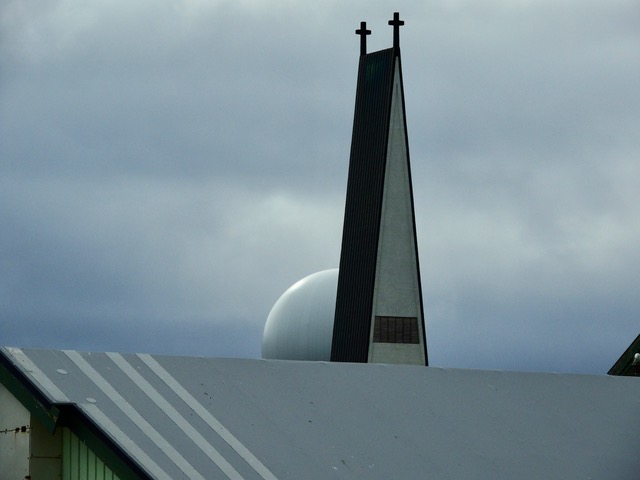
Except that for those within earshot and who were interested – which might have been only me – Gerard had made some comments about how Vardø had a strong NATO presence and that Americans had been part of that scene for quite a few years. He had also made a comment earlier about how just a ways down the mainland coast as one headed east lay Murmansk, which in fact is the world’s largest city above the Arctic Circle, and nearby is the main headquarters of the Russian navy’s Northern Fleet. Before the trip I had failed to do any snooping regarding Vardø on the web (all I could think about was PUFFINS, as you might assume), but on Wikipedia one finds cryptic comments on how since 1998 the town has been a Globus II radar site, purportedly to monitor “space junk”, except that there has also been “an alleged connection” between Globus II and American anti-missile systems, and how the proximity of Vardø to Russia seems more than co-incidental. The upshot of all this is that “the site has been the basis for heated controversy in diplomatic and intelligence circles”. Whoa.


But hold on, it gets even better: it also mentions plans to update to Globus 3, and how “the Russian military considers it a threat to its national security.” The trip itinerary had included none of this, rightfully so I imagine, with its total focus on the natural world and the nearby nesting colony (especially the PUFFINS) which is what ecotourism is all about. But there are some of us who love James Bond and Tom Clancy and John le Carré, as well, who come from a world for which a Cold War setting like Vardø is very cool, indeed, and one whose overall vibe supports all kinds of overcooked suspicion and paranoia, if one is in the right frame of mind. Like that tunnel, for instance, as we shall see.

For now, just a few more things: Vardø currently has about 1900 inhabitants, is spread around Vardøya Island, which lies east of St Petersburg, Kyiv, and Istanbul, and its main claim to fame has always been as an excellent fishing port. It has a fort that dates from the 14th century and Vardø was the site of witch trials in the 17th century that led to the execution of 91 women, for whom there is a memorial in town (Salem MA, which bills itself as the “Witch City”, where Halloween is a major tourist event every year and whose tragic story inspired a major play by Arthur Miller, “only” executed 25 in comparison – did Henrik Ibsen drop the ball, here?) And the proper spelling, it seems, is Vardø and not Vardö as the trip itinerary suggested, which it turns out is an underbed storage unit offered by Ikea. I am not kidding, but then this is all getting rather petty, isn’t it? Mea culpa, and my apologies to whoever writes the itineraries for Naturalist Journeys, LLC, who are a great outfit.
And to get to Vardø we had to first leave Bätsfjord and – somewhat reluctantly – the African suite of the Polar Hotel, drive through the stunning visuals of the highlands of the Veranger peninsula, and in a roundabout fashion finally get to where we were going, as the roads dictated in this remote place. Of course it’s all about the journey and not the destination, as you well know, even when that destination is a place like Vardø and Hornøya island, where we would see PUFFINS and so much more.

If you look at the huge and splendid topo map that spanned a whole wall of the Hotel Vardø lobby (why don’t all hotels have things like this?), Bätsfjord lies in the middle of the peninsula’s northern coast, while Vardøya and Hornøya islands sit just off the easternmost coast. From the quaint fishing port one heads southwest to the head of the Varangerfjord and then follows the coast northeast, where the landscape is lovely and remote, with way more sheep visible than people and a great many birds down in the ocean and in the scrubby pastoral landscape, a few of them perched co-operatively on the many fenceposts while white-tailed eagles “patrol the shoreline”, exactly as the itinerary predicted. At some point off in the distance one sees the island and the town with its distinctive white radomes and as you get closer the road turns right, towards the ocean until most weirdly and unexpectedly (if you’ve never been here) it drops down into this tunnel, built in 1983 and personally blessed by King Olaf, who made a special trip here just to dedicate it. And quite a tunnel it is, narrow and strangely lit (though it might just follow some European convention) and almost two miles long which means one is in there for what seems to be quite a long time. So had our journey to the End of the Earth turned into a journey to the Center, after the great sci-fi movie? Or was this a wormhole to long ago and another galaxy far far away? Sleep deprivation and jet-lag, even after many days, can inspire such thoughts. If you’ve been through the Mont Blanc tunnel maybe you are unimpressed and I really don’t care.


Coming out of the tunnel one is greeted by a mix of drab and colorful buildings, the prettiest of which are the chosen nest-sites of clusters of black-legged kittiwakes and the resulting whitewash in the style of Jackson Pollock (or did he borrow from them? in the beginning there was only the First Artist, as you might have heard). Hotel Vardø where we stayed presented the starkest contrast to Polar Hotel one could imagine, by far the slickest and most corporate-looking of all our lodging, except for maybe the ski resort at Ruka. But Vardø otherwise had no resort aspects whatsoever. At dinner, there were various folks in military garb, which suggested something about the clientele at this place, who were clearly not bird watchers on the lookout for PUFFINS.


Of which there were none in the town, as seabirds of the alcid family tend to appear over the open ocean and on their breeding islands and that’s about it, as opposed to birds like those kittiwakes and most notably the arctic terns, nesting on the gravel right outside the hotel, in plain view from the hotel restaurant up above. Which was about as good a look as one could get, as any attempt to approach them would immediately inspire one or several hovering in front of one’s face at about fifty yards, making noises clearly expressing some level of annoyance or more likely threat, and this photographer opted on the side of caution over art and the resulting image is most unimpressive, with no apologies. Arctic terns are, by the way, one of those marathon-level migrants, and comparing their 44000 mile annual circumpolar migration to a 26.2 mile jog is really rather pathetic, isn’t it? On the plus side, for an arctic tern it’s summer all year long, if one doesn’t count travel time, and perhaps they don’t.


Avoiding the terns and walking through the rest of town afforded a stunning range of visuals, from the colorful to the odd to the merely mysterious. There was also the usual sparsity of people about and an unusual amount of auto traffic for such a remote and quiet place. Who were they and where were they going? There was any number of abandoned dwellings, some so rundown it suggested abject poverty or even some kind of drug activity to this cynical life-long city dweller, not to mention the looming presence of those white radomes up on the hill, and then that bizarre church steeple, that made me wonder if it housed some giant antenna or other non-religious “item”. A spy novel fan could not be blamed for allowing the imagination to roam freely in such an environment, and at some point we were randomly approached by a local person for the only time on the trip, who seemed pleased we were interested in his town and who walked with us for awhile, giving some history and pointing out landmarks in broken English that was difficult to understand, at times. At some point I almost expected him to invite us to follow him into the doorway of some rundown building where we’d proceed down a corridor then to a secret elevator that would take us deep underground to some command center where we would divulge our secret “mission” (which was to see PUFFINS, which was no secret at all) but thank God it never came to that.


Vardø also afforded buildings with some really splendid artwork and/or graffiti, and then there was that huge and striking Viking-boat-cum-whale-backbone just outside of town that we happened by while searching for birds, as depicted back in post #1. Or maybe Matti knew it was there and wanted us to see it but Matti wisely rarely tipped off his real intentions so we shall never really know. In the general scheme of this trip, Vardø was clearly a sub-destination to the Big Show the next day, Hornøya with it’s spectacular offering of nesting seabirds (including of course an alcid that shall go unmentioned) but one of the appeals of travel is its promise of the unexpected that can turn out pretty great sometimes, and Vardø definitely turned out to be that. Of course in the end we didn’t get to be part of some Bondian plot, but then Ian Fleming and Hollywood are way better at doing those things than reality anyway, wouldn’t you say?


