So much difficulty and sorrow in life, so many ways to cope! There are the traditional tried and true means, old standbys like religion, or seeking wise counsel from family and friends, and in the modern era the troubled have the option of professional help. Throughout history there have been those who successfully leave despair behind by taking up a higher cause and fighting the good fight in the name of righteousness, and if all else fails, there’s sex and drugs and rock and roll. Anything beats silently suffering those nasty slings and arrows, day after day, unless you’re some kind of masochist, which of course you might well be, and have you considered getting help for that?
Aside from longterm strategies, what about just taking a break now and then? When this old world starts getting you down, in those moments when you’re feeling tired and weak and you just need to get away, if only briefly, from the rat race and the hustling crowd, where do you go? You can follow the advice of the classic song and go up on the roof, but the fact is that’s difficult if not impossible and in some cases outright illegal for a great many people, given all the variations to be found in the dwellings of the many Carole King fans throughout the world.
Those denied roof access can always sing or hum the song quietly to themselves, or play it on their device, whichever of the many versions they favor. There’s the original Drifters rendition from 1964, then of course the one a few years later from the songwriter herself (who co-wrote it with her husband Gerry Goffin, never forget). In the current day many in Massachusetts seem to favor local boy James Taylor’s version, and some of us would choose Laura Nyro’s intense offering if we had to listen to it every day into eternity. Heaven help us if it ever comes to that, not that it isn’t a really great song.
Our classic Boston three-decker here at 39 Iffley Road does, in fact, have a broad, flat roof covered in rubber, and living halfway up a hill, the view from up there is downright spectacular. Whether the air is fresh and sweet can be a matter of opinion, especially if a fire truck has recently driven by, and when some guy is circulating the neighborhood blasting hiphop or some Latino anthem on his megawatt sound system, no way is it peaceful as can be.

Getting there is also not as simple as climbing way up to the top of the stairs. At the top of our stairs there’s the added step of pulling the ancient wooden ladder off the wall on the third floor porch (out of respect one should also warn the tenants up there that you’re coming), placing it under the hatch, and climbing quite a few rungs. If you’re smart you’ll make sure somebody’s holding that ladder steady, because at the top you’ll have to push that hatch (it’s heavy!) out of the way. Finally emerging onto the porch roof is where life finally more or less imitates art, as it is truly inspiring up there, just be careful not to go near the edge. If you’re fearful of heights, the distraction might lead you to miss out on an uplifting experience, life canceling out art in your case, and too bad. For you it might be better to just stick to the ground and listen to a recording, or better yet, sing it.

Even better than that, come join me in the basement, just a few steps down through the door in the side yard. The view is mostly of bicycles and endless shelves of stuff in storage, hot water heaters and laundry appliances, none of it all that inspiring but also not at all scary, totally familiar in a domestic way. And of course the bikes are all lovely and beautiful, if I do say so myself. This can be a serene place of deep meditation and profound thoughts at times, and is the occasional smell of fresh laundry drying on the line (we don’t own a dryer) not inspiring in its own way? Is there a song here waiting to be written?

Admittedly a basement may not be everyone’s cup of tea, either. The fact is, a paradise that’s trouble proof might be waiting anywhere, for the right dedicated seeker. There’s the majesty and and serenity of the mountains, which some claim are alive with the sound of music, and if you can afford a plane ticket to Denver, will that Rocky Mountain high do the trick? On the other hand airline travel, so loaded with multiple stressors nowadays, might make matters worse. The fact is, an effective getaway might be right under your nose, with a pleasant hike in nearby woods or just walking your neighborhood, so long as your streets are free of the rat race noise that prevails on most busy thoroughfares. Choose your route carefully!

Then of course there’s the beach, far and away the #1 choice of much of the world when the conversation turns to paradise and getting away. One wonders if Carole King in a candid moment would admit that claiming a rooftop can resemble a paradise is a bit of a stretch, poetic license at its most licentious. Or maybe living in NYC the only beach she knew was Brighton Beach out at Coney Island, where there’s lots of fun to be had, but any notion of paradise is elusive.

One hopes you’ve had at least one great beach experience in your life, which almost always includes the classic sunset over the water. If you’ve yet to witness such, put it on your bucket list and do whatever it takes to get there when the time is right. You can pray for clear weather, though the experienced will tell you having some dramatic clouds can be a great enhancement, while having too many is a letdown, so good luck. It needn’t be a broad sandy ocean beach in Hawaii or California or Florida, either: sunset on Lake Michigan, for instance, viewed from the Indiana dunes, rates with the best, ask any Hoosier who’s been there.

An inordinate percentage of tourist industry profits stem from those places where land meets water and romantic fantasies run rampant. It is also true that for many the reality never quite matches the hype. For all the wonderful beach memories in the collective human consciousness, whether real or seen in a movie somewhere, there are those of us who can recall that a typical day at the beach is often as not about something else entirely. Where it’s all about sitting on incredibly hot sand and getting too much sun, feeling all your pores drying out as the fabulous view of sky and water gets less enchanting as the hours pass, while you try to focus on whatever light and amusing (as in trivial) “summer reading” you’ve brought along, all the while getting distracted by those guys tossing a frisbee over your head and somewhere within hearing range there’s a radio playing Taylor Swift or classic rock, endlessly. In the old days there were also cigarette smokers, but they seem to have disappeared, thank God, though probably not on the Cote d’Azur because that’s in France.
Perhaps you find that summation a bit unfair, too curmudgeonly? Fair enough. In his defense, this writer is ready to reveal to you one beach he has found that is quite out of the ordinary, where truly unique beach moments can be had, at least when the wind direction is right. And from Iffley Road it is only a transit ride away, just hop on the Blue Line out to Wood Island or Orient Heights in East Boston (doesn’t this sound great already?), and from there it’s but a short walk to Constitution Beach, once you’ve crossed over the tracks via the Anthony and Dee Dee Marmo pedestrian overpass.
The beach is but one feature of Constitution Beach Park, which means if you get tired of lolling on the sand and staring at the waters of Boston Harbor there are baseball fields and basketball and tennis courts, a picnic area and concession stand and convenient restrooms. Do Waikiki and Copacabana offer such a fabulous choice of amenities?

Ah, but the best part, the most endearing aspect of this place that makes it something truly special and unforgettable, awesome and breathtaking and mesmerizing at the same time, is to be encountered on those days when the wind blows gently or fiercely from the south or the west. Those happen to be the days the General Edward Lawrence Logan International Airport, right there across the water facing the beach, will be employing Runways 22R and L for the day’s operations.

One look at the picture says it all. Have you ever beheld a beach scene as magnificent as this? Can you imagine the sound of that gorgeous wide-body jet – which here appears to be a Boeing 777 – spooling up its massive turbofan engines, preparing for takeoff? Then watching it begin to roll – a machine that weighs somewhere the other side of half a million pounds, and on top of that it flies – slowly at first but not for long, before it blasts away towards Dubai or Paris or Philadelphia? While you lounge there on the sand, or shoot hoops or whatever, with a front row seat? Can life get any better in that moment?

Or better still, witness the drama of one of these giants suddenly appearing above the northern horizon, growing larger and larger, its fourteen wheels dangling below, like the talons of a raptor zooming in for the kill. In reality, arriving big jets approach the runway incredibly slowly and appear to be almost hovering, which adds to the spectacle. You can hear the pitch of the engines rise and fall, correcting to keep the descent at the perfect angle and speed, followed by the squeal of all those tires at the moment of touchdown, suddenly spinning at 160 mph. And all of this for your entertainment, from your front row seat. And at certain times of day, this happens every minute, and can sometimes go on for an hour or more. Whew!

Those with less enthusiasm for this sort of thing might best avoid the busy times of early morning and late afternoon, though there’s some activity throughout the day, but only when the wind is right. Those with no enthusiasm at all can hope for a change in the wind direction, or take heart in the fact that there are countless other beaches beckoning throughout the Commonwealth, Cape Cod, and the world. It is also true that many of those are better known and often hideously overcrowded, victims of their fabulous reputations. Has it been mentioned that Constitution Beach offers ample convenient free parking?
A major commercial airport, cozying right up against downtown, so strange. Almost all the big airports of the world, demanding vast swathes of commercial acreage, tend to spread their giant footprints goodly distances from the cities they serve, making it quite a hike to your hotel once you’ve exited the plane. Logan, along with San Diego International and Reagan National down in DC, are the exceptions. So convenient! So advantageous, at least for the traveler, though maybe not such a great deal for those city dwellers living their lives directly beneath the various flight paths of the big planes, with all their comings and goings.

City dwellers like us, for instance. Four miles south of Boston Common and next to Franklin Park, the largest green expanse in the city and a major landmark from the air. This means that those days when the wind blows gently or fiercely from the south or the west, runways 27, 22R, and 22L are the runways of choice, and would you believe their departure routes carry them right over the park and our house? A circumstance that often as not begins at six in the morning and can go on, a plane every minute, for as much as an hour at a time? Also bear in mind that these are departing aircraft, still on takeoff power clawing for altitude, which means noisy. It is also a fact that modern jet engines employ noise suppression technology that has been refined for years at this point, and did you know that? Small comfort for us, and it was undoubtedly worse in 1959. Am I complaining? Of course not, but thank God the wind around here blows from the north and the east blessedly often.


On the roof the planes go soaring by / And you can almost touch them, if you try…
It is on those days that planes approach from the south and west of the city, out over Dorchester Bay and Castle Island, that one can thrill to their passing just a few hundred feet over one’s head, mere moments before they hit the runway a half a mile to the north. At Castle Island (a true island no longer, due to the city’s landfilling mania) one can chow down on hot dogs or fried clams from Sullivan’s, sit on a comfortable bench alongside Fort Independence (built in 1850, though there have been fortifications on this site since the 1630s), and chat with friends and passers by, except for those moments when the scream of jet engines drowns out all other sound, and yes it’s that loud. If one is restless one can walk or run or skateboard the unique causeway that circles around evocatively named Pleasure Bay. One might pause in the parking lot to toss remnants of one’s hot dog bun to the ever-present gulls, generations of whom have been Sullivan’s regulars since the day it opened in 1951, but be wary, as they can get aggressive and they outnumber you by a lot.

What adds to the experience is the fact that one cannot see the airport from here, yet those planes look so damn low. For the air traveler looking out the window from up there, especially the first time, coming in on this southern approach means the plane gets lower and lower, the harbor below closer and closer until it seems very close, indeed, and are we about to hit the water? So exciting! Then you pass over Castle Island and bang! you’re on the runway, 4R or 4L depending. So cool!


But alas, in South Boston one is deprived of the full airport-viewing experience, as well as all the special pleasures of Constitution Beach, where the dazed plane-spotting beachgoer has much to contemplate. For one thing, they can ponder the mental status of the hundreds of unseen people behind those rows of aircraft windows, on their way from and heading out to parts unknown, and can you believe this airport served over 43 million of them in 2024? Consider for a moment all that collective excitement and anticipation, as the multitudes enacted their various getaways. Let us also not forget those travelers who might’ve been a bit less sanguine, those on their way to business conferences or military boot camp or to visit family with the purpose of asking for money. Anything is possible in the grand realm of the human condition, and no wonder some idlers at Constitution Beach appear to be totally lost in thought, trying to get their heads around the enormity of it all.


Those contemplative beachgoers with a historical perspective, if there are such people, might gaze across Logan’s vast expanses and marvel at how air travel has been a thing here for over a hundred years. They might imagine how previous to that they would’ve gazed across these waters and seen nothing but Apple and Governors Island, out there in the watery distance, when the only aircraft that might’ve tried a landing or takeoff would’ve been a seaplane.

Following the time-honored Boston precedent of turning water into land, the same industrious process that swallowed Castle Island similarly did a number on Apples and Governors. In the beginning it was cleverly named Boston Air Port (pretty catchy, no?) and by the mid 1920s there were a couple of runways and regular airline service. 1930 saw the first so-called occurrence, which is airline safety lingo for an accident of some kind. A Ford Trimotor taking off on a fine June day with fifteen people aboard had an engine fail on takeoff, which sent it into the water. One person drowned, and it would’ve been a lot worse except that it was low tide. Those were simpler times.


Occurrences in the airline trade are actually quite common, with the vast majority of a minor nature, as in “nobody gets hurt.” But it is those occurrences we all remember that lend credence to the so-called fear of flying that afflicts so many of us, quite possibly you. Consider the case of so-called bird strikes. It is a fact that birds are found around airports. For one thing, airports tend to be huge expanses of wild habitat, grassland or tundra or whatever. Sure there are noisy planes around and about, but much of the time it’s relatively peaceful out there by the runways, and uninhabited grassland provides great habitat for mice and voles and rabbits and such, a great source of food if you’re the right kind of bird. Airports surrounded by water offer another entire ecosystem with its inviting habitats, and those who remember that plane that landed in NYC’s East River (as dramatized in the movie Sully) when it’s engines cut out on takeoff might also recall that the cause was a sudden inhalation of Canada geese. No humans died but quite a few birds did, something few consider and even if they did the poor Canadas have a lot of haters out there who might say good riddance. It’s a sad world sometimes.

A similar story took place at Logan Airport many years before, on an October day in 1960, with a few crucial differences. It was 1960, so early in the so called jet age that the plane involved still had propellers, though they were modern turbine-driven blades which allowed the advertising people to brand them as “prop jets”, so silly. The plane was a Lockheed Electra, an especially lovely design if you’re an airliner buff, and this particular plane belonged to Eastern Airlines in one of the loveliest paint schemes ever – look at the image and see if you agree. Anybody at Constitution Beach on that day would’ve been spared the horror of watching Eastern Flight 723 take off towards the east on runway 9 and run smack into a giant flocks of starlings – some estimates go as high as twenty thousand birds – out over Winthrop Bay. The engines quit, the plane hit the water and broke in half, and 62 people died. The proximity of the airport to the city might be part of the cause, as starlings are hugely numerous throughout Boston, like in many cities. It is hardly a positive note, but those were the first fatalities at Logan since that Trimotor occurrence 30 years before.

The Logan history buff, sitting there on Constitution Beach, must acknowledge that any survey of all of recorded time offers up a smorgasbord of highs and lows, good times and bad and everything in between. On the one hand they can smile and take comfort in watching anonymous but mostly joyous travelers managing their various escapes behind those rows of airplane windows. On the other hand, it can be a useful and grounding experience to soberly contemplate the handful of tragic Logan episodes that are part of the story as well. We can all handle the truth here, can we not? Are a few tragic moments not infinitesimal when compared to the thousands of flights and millions of travelers whose experience was, while maybe not a total pleasure (unless they flew first-class). was uneventful and frankly kind of forgettable.

The true Logan history buff will then contemplate why it is that tragedy clings so doggedly to our collective consciousness. It is those stories that ignite curiosity and whose details are readily available in aviation records and on Wikipedia. All the flights they’ve observed today, along with those preceding, as they loll there on the beach, are fun or maybe a thrill to witness, but will not be long remembered.
The remaining list of tragedy at Logan is thankfully quite short, though any list at all is too long from the get go. There was Delta flight 723 approaching runway 4R over Dorchester Bay on a foggy late July morning, thirteen years after the Eastern incident. Does anybody at Castle Island in that moment recall if it looked a bit low as it passed overhead? It’s possible the fog was thick enough that they only heard it. Did they also hear it fall short of the runway and hit the seawall just a few moments later? If they did, was it at all clear what had just happened? The available historical record offers no eyewitness accounts, though it was surely a topic of major interest in the Southie bars over the following weeks, and who knows what was said?
So take heart everyone: that’s it when it comes to terrible crashes at Boston’s airport-in-the-harbor, and please note that the Constitution beachgoer would’ve only seen but one of them, that Trimotor back in 1930 at low tide, and only if the place was even a public beach at the time, which maybe it wasn’t. There is, however, one prominent footnote to this story, where prominent may be an understatement.
Bostonians today who were around at the time will tell you what a fine September day it was, back there in 2001, not at all unusual as it’s the time of year when the warm (or downright hot) humid air masses of summer get replaced by dry cool air blowing down from Canada. The operative word is crisp and the corresponding emotions are relief combined with a kind of joy and it’s so long summer! you overstayed your welcome, as usual. The early morning denizens of Constitution Beach on that particular day probably had their hoodies pulled up as they marveled at the intense blue of the cloudless sky and the chill in the air, hallmarks of the month and the season, glorious.

The breezes from the north meant the planes were heading out and up on runways 4R and L, well clear of the runway by the time they passed the onlookers trying to stay warm, especially the smaller jetliners whose takeoff runs are designed for shorter runways than the ample distances provided at Logan designed to handle the big planes, the so-called wide-bodies. In fact, the more astute plane spotters might’ve thrilled to the near proximity of a couple of these just lifting off towards the end of the runway, Being 767s headed for Los Angeles and heavy, with full loads of fuel for the long flight. The first passed by just before 8am, followed by the second about 15 minutes later, and if you’ve been paying attention you might have figured out by now that neither of these planes ever made it to the west coast, crashing instead into the World Trade Center towers in NYC less than an hour later.
In fact, was anybody at all at Constitution Beach on that particular morning in those moments? If there was, what must it have been like to learn of the event and realize Jesus I saw those planes full of people heading for disaster when nobody had a clue. Most people who were alive on that day can tell you how it all played out for them personally, New Yorkers in particular, but Boston played a major supporting role. Every year on 9/11 there is a memorial service at the MA State House to remember the 219 people with Massachusetts ties who died on that day. There are speeches and tears, a shared moment to recall not just the losses and the suffering, but also the heroism and courage of so many, which is also part of the story, whose aftereffects continue to ripple through the present moment in history.
There is of course no single 9/11 story, arising as it does from the collective memory of countless stories that add up to the total event. And that event, as momentous as it was, in the end was just another story in the Story of the World, which is all the stories happening in this moment and the next one, as well as the infinite number of those preceding. All of them matter in one way or another, and the sum total we might call the True History of Everything, something the likes of which no single person can ever begin to know in total, which is as it should be. So now, in the spirit of sharing one small aspect of Everything of which you might not be aware, allow me to familiarize you in this moment with Norm Smith, who appropriately happens to be an important player in the story of Logan Airport.
This brings us back to what’s up with those birds hanging around airports, all of them potentially lethal to the many humans acting out their various escapes in their airplanes. There are the starlings and Canada geese already mentioned, but what about all those gulls, or the many ducks in the wetlands along the harbor, coots and grebes and teals and whatever? We actually witnessed first-year bald eagles walking along the runways in Victoria BC on Vancouver Island, many years back. We all know what the aviation industry did to cut down on terrorists bringing down planes, but what about the birds? As you might guess, various forms of violence were long the norm, shooting and poisonings and such, but in more humane times airport people have taken to limiting prey habitat, keeping the grass short and doing rodent control, as well as playing recordings of shotgun blasts. Nowadays they also use drones but probably the most useful method has been the refinement of radar, to the point where controllers can see large flocks and calculate the threat. In spite of all this, bird strikes still happen, usually minor events.
It is not clear just when the buildout of Logan reached a point where it was vast enough to catch the attention of Bubo scandiacus, aka snowy owls. Was it just the voles and mice taking advantage of this nifty new ecosystem, so similar to the their favorite food up there in the tundra, which is lemmings? Was it the presence of fish and various duck species, coots and grebes and teals and such, not to mention those geese? The snowy is not choosy, and it is big and heavy and aggressive enough to take on all manner of potential prey when hunger calls. The similarity of Logan’s winter expanse to the owls’ tundra home has often been cited as a factor, and when the winter winds blow in from the ocean, the comparison is more than apt.
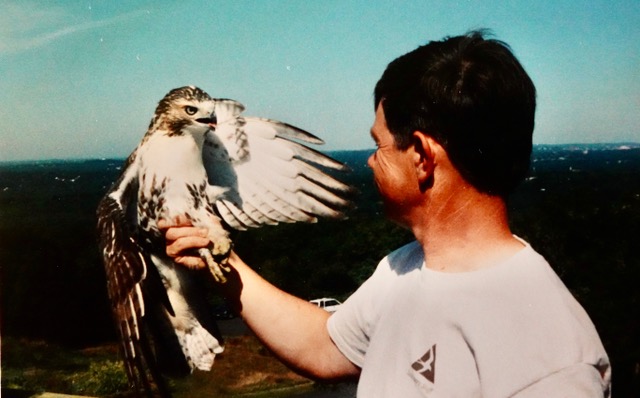
When it comes to airport safety, the owls that show up every winter actually do their part in reducing the presence of other birds that threaten airborne Homo sapiens, as explained above, but then the bird itself remains a part of the problem. Which is where Norman Smith comes in, not just a Massachusetts Audubon guy but also a raptor guy, who has made a career of capturing, banding, and releasing birds of prey. This kind of thing has been a regular practice in ornithology since forever, but consider the difference between going after sparrows and finches and such, and big birds who fly fast and come equipped with large sharp talons and beaks designed to tear up flesh.

We got a chance to see Norman and the birds in action on one of the greatest escapes of our life, 40 or so years ago, after climbing way up to the top of the stairs on a tower high above Chickatawbut Hill, ten miles south of the city. Imagine the scene: our little crowd jammed onto that small platform with Norm, while somebody down below had a pigeon on a tether, which they’d yank on now and then in an attempt to draw the attention of any and all birds of prey that might be in the area. It seemed like a rather odd and impossible strategy, but the knowledgeable Mr. Smith explained the unreal visual acuity of the raptor eye, designed to see unbelievable detail at great distances.

This means that at various times throughout the afternoon, he’d point out some bird off in the distance over Milton or Mattapan, at first only visible through binoculars. Slowly, slowly it would come our way, a tiny speck in a vast blue sky, growing ever larger, though nowhere as large as seeing an airliner from Constitution Beach approaching runway 22. “Large” in this context does not, in fact, describe these birds, at all, which in no way diminished the dramatic effect. Closer, closer they’d come, zeroed in on that pigeon, only to get stopped short by a so-called mist net, which in the heat of the moment they had failed to notice, until it was too late.

Things would get even better, as Norm would then proceed down, extricate the shocked hawk or falcon from the net, and carefully insert it head first into a coffee can. Needless to say, they had several sizes of these to accommodate the various species. The same can be said for the wrist ID bands, which ran from the tiny, so as to fit snugly on the cute & diminutive American kestrel, all the way up to Golden eagle, whose band would fit nicely on the ring finger of many a homo sapiens. The banding ritual took place at the top of the tower, and you wouldn’t believe how docile a wild bird of prey becomes with its head stuck in a coffee can, though the sport of falconry has long used leather hoods to the same end.

You also wouldn’t believe the shock and awe of staring one of these birds in the face once it was pulled from the can, in the practiced grip of our host and its captor, at which point some of them appeared very large, indeed. Norm would then hold it up for a few moments, to the appreciation of all, before releasing it, in what can only be described as a grand moment. One wonders what went through the minds of those released birds, beyond some kind of bewilderment over what had just happened, and where the hell did that pigeon go?

It was about that same time, all those years ago, that Norm became aware of the owls showing up at Logan. Being an ornithologist with his special bag of tricks, he offered to limit the danger of snowy owl strikes out there on the quasi-tundra while also doing his part for avian research. The result was one of the more fortuitous and original partnerships in the annals of aviation safety, as well as a means of unraveling some of the mysteries of snowy migration, eating habits, and lifespan. A great leap forward in this regard occurred when Norm later equipped some captured owls with radio transmitters. If you’re keeping score, he has captured and banded over 900 owls over the past 40 years.
Those owls have not been released at the airport, but trucked some distance away before getting set free. Of course some probably show up back at the airport sooner or later, while many move on to other hunting grounds, finding their personal experience of Logan airport something not worth repeating, no matter how delicious they’d found the menu.
In the end, we Homo sapiens can only speculate about the animal psyche. Observation and experiment can only get us so far; after that it’s guesswork and wonder and ultimately acceptance of another of nature’s mysteries. Is a bird, trapped and banded and released, traumatized forever, if at all? Do they even conceive of anything like escape? Do they harbor notions of getting away, of the sort that grabs so many humans at various times, when for them life has become intolerable in a sometimes mild or sometimes truly oppressive way? When birds escape, if escape is even the proper word, it’s not up onto a roof or in some more involved getaway, but up into the very sky itself, all on their own, spontaneously, where they can then remain as long as they please, only to come down wherever they want, when they get tired or hungry or it simply suits their mood, if mood is even the right word. Humans might try to write songs about this but in the end there’s no way they’ll ever get it right, because they can’t.