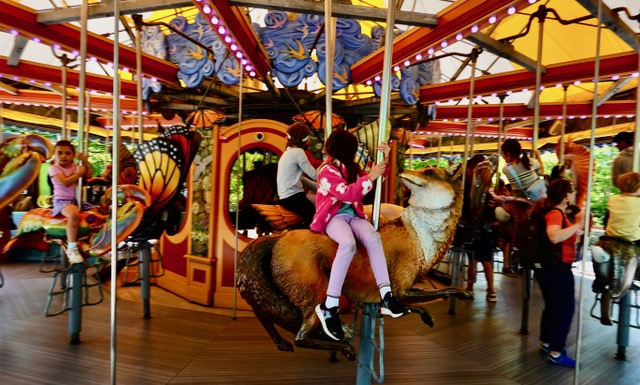
As a topic for idle speculation, nothing beats time. Time: conceptually profound and elusive in so many ways, yet with a hard edge that has already blessed you with a beginning and a past, a middle that you are living in the present moment, and a future that will include some sort of ending, as in the end of you. This includes the end of any further speculation of any kind on your part, including thoughts about time. In spite of this, the all-time master of idle speculation, none other than Albert Einstein himself, had the nerve to claim
“the distinction between past, present, and future
is only a stubbornly persistent illusion” and
“the only reason for time is so that everything
doesn’t happen at once”

Of course he’s the one who should know, if anybody does, but that doesn’t mean his insights are necessarily helpful, beyond supplying fodder for further idle speculation.
Aristotle, the know-it-all guy from antiquity, was a lot more down to earth about the subject
“Time crumbles all things; everything grows old
under the power of Time and is forgotten with
the lapse of Time”
Ari’s words are quite a bit easier to grasp, but are also open to skepticism, given that he himself is well-remembered all these years later. Our knowledge of his writings makes him kind of an exception to his own claims; that said, it cannot be denied that much of what existed in his day has, indeed, been lost to history. The same could be said for much that preceded him and all that has passed since, including what existed last week or even just a few minutes ago, if you’re old enough to be suffering from short term memory loss, and has anybody seen my car keys?
Time is linear, forever moving ahead, relentlessly. Yet we tend to measure it in a way that is decidedly circular – the days that are dictated by our planet spinning on its axis, the seasons that pass with that planet’s yearly journey around the sun, the very same journey that determines our birthdays, which tend to get remembered as long as we’re alive. What happens after that is anybody’s guess, though Aristotle certainly had his rather downbeat opinion about that. Do you worry about being remembered when you’re gone? Let it go!
One observation, probably as useful as any on this topic, goes
“Time flies like an arrow; fruit flies like a banana”
While you are pondering that, consider also the well known offerings of the singer-songwriter from Saskatoon
“And the seasons they go round and round
and the painted ponies go up and down
We’re captives on the carousel of time
We can’t return we can only look
behind from where we came
And go round and round and round
In the circle game”
It is a child’s vision, crafted into a song that takes us through the early stages of life. In four verses we go from from initial innocence to a growing self-awareness of time’s passing, then on to the first realization that time passing one by is intensely real, and that this might not necessarily be a good thing. Look out! Youth is slipping away, and you’re gonna miss it! Drag your feet! Yeah, good luck with that, and don’t sweat it, kid, you’ll always have your dreams.


This perfunctory exegesis may make more of the song than what is really there. It was penned when the writer was still in her early 20s, a time in life which for many is not a time of particularly deep reflection about much of anything, other than figuring out how to get ahead in life as an adult. But then genius is a funny thing, and history suggests the writer had more that her share of it, as her subsequent artistic endeavors were to prove over a long and eminently successful career. Now in her 80s, would she still agree with her long-ago assessment of time?
Profound or not, it cannot be denied that the tune is diabolically catchy, the song overall as excellent an ear worm as one might imagine. There are some who remember it as a campfire tradition, sung every night for the duration of their away-from-home experience. The more candid among them will tell you they got kind of sick of it, but maybe that’s just further acknowledgement of its power.
And what about the curious fact that it was composed the same year – 1966 – that a poem with the same title was published by the eminent author from Toronto, one which she’d written a few years previously? Her poem opens with The children on the lawn/joined hand to hand/go round and round. This author was to have her own long and successful career, not just in poetry, but as a novelist and essayist, focusing on sharp political and social commentary, among other things. Her version of The Circle Game also involves youth, though it comes off as more of a dialogue between children and grownups, and delves into topics like perception and reality, power and struggle, and the need to resist the cyclical structures of society that trap and restrain. At nearly 300 lines long, it would be tough to sing it, if it even had a tune, but songs were not this author’s forté. If it says anything about time, it expresses it much less simply and directly than the songwriter’s effort, but if you’re curious maybe you should just check it out yourself. Just be prepared to do some heavy thinking, and you might consider starting with a few cups of coffee.

In its brevity and simplicity the song presents quite a startling contrast. It is the refrain that burns itself into one’s consciousness: the endless spinning of the merry-go-round, the undulating painted ponies ridden by the captives of time, who are presumably children; a carousel is a kiddie ride, after all. In this context, “captive” seems a bit harsh, though newcomers to the ride undoubtedly whirl around unaware; youth is as much about ignorance as it is innocence, and ignorance is not always a bad thing. The story is all about growing older and wiser, but in some ways the thought of being captive on a carousel forever, or at least for an entire lifetime, remains kind of disturbing; one wonders if Rod Serling could’ve worked it up into a Twilight Zone episode. At which point the songwriter, if she were here, might deliver a well deserved dope slap and say “cut it out, silly, you’re thinking about this way too much!” and she’d be right. She’s the one that wrote the damn thing, after all.
Round and round. Up and down. I should at least tell her that her song has come to mind a lot lately, in a kind of earwormy meditative fashion, as part of a recent habit of doing laps in the local park. Round and round: 2.2 miles with each revolution, bigger than any carousel one might imagine. Up and down: there’s a steady half-mile climb at one point, a two or three per cent grade that may not sound all that steep, but a half a mile uphill can seem like a long ways, especially coming around for the third or fourth time. The payoff is the series of downhill stretches on the back side of the loop, where it’s easy to hit twenty miles an hour or more. On a hot day the breeze this creates is pure joy; the fact that the route lies mostly in the shade is a bonus. Talk about simple pleasures!

Did I say my painted pony is blessed with a couple of wheels and pedals? Kudos to you for figuring that one out, though anyone familiar with what goes on at this website would’ve guessed it right away. The more interesting aspect of the activity concerns the roughly circular venue where it all takes place. We’re talking Franklin Park, covered at some length elsewhere at ravinginbeantown if you go to Jamaica Plain-speaking/Tale from a City (1) and (2). It would behoove you to check those out before proceeding further, but if you’re feeling generally overburdened with information at the moment, never mind and full speed ahead.

What you do need to know is that Franklin Park is one of the better-known offerings from the 19th century landscape-architect genius from Connecticut, who achieved rock star status, of a sort, back in the day, when major urban parks were a very big thing, indeed, and were those not very different times? Agricultural economies were shifting to industrial, the countrysides were being abandoned for the cities. This had been going on for a century or two already when a few enlightened students of society and public health got the notion that something important had been lost in the transition. The tranquility of country life and living in close contact with nature met certain human needs that were no longer considered for those living in cities. Prominent thinkers like William Wordsworth and Ralph Waldo Emerson wrote of the “restorative value” of rural scenery and all that was considered pastoral, but the average urban dweller had little regular access to such places, if any.
The landscape architect was more than a guy who designed parks; he was a poet of the pastoral and the picturesque, a believer in what the philosopher Edmund Burke described as “the sublime and beautiful.” What was special is that the landscape poet worked not with words but dirt and rocks and plants and topography, the same topography that I encounter on my wheeled painted pony, as we go round and round. We’ve come to know it intimately.
We can’t return, we can only look
behind from where we came
Is it possible the songwriter didn’t get it quite right? Can riding round and round in a landscape purposefully designed a hundred years before to restore peace of mind bring true return of some kind? Or in the end will it be just a look, and an unsatisfying one at that? Does the landscape poet pull it off all these years later?


To explore this possibility, probably the best place to start is by way of an ancient-looking and well-preserved portal, one with a quaint and curious name like so many features in this Victorian space: Ellicott Arch. In the 21st century, it beckons one back to a different time. Doing so takes one under Circuit Drive, one of the park’s original carriageways. This short tunnel is more than a minor design detail; it is a reminder that the landscape poet’s creations came at a time when his parks served a mixed crowd of walkers, horseback riders, and the wealthy going about town in their carriages. In our great democracy, they were parks for all of the people, and they were well used.

For safety’s sake and to avoid conflict, the park’s design kept each in their own lanes, with specifically designated walkways and bridle paths separated from the major carriageways that were a dominant feature. The landscaper’s first and probably best known creation, Central Park in Manhattan, even had four crosstown streets passing in channels unobtrusively beneath the park landscape above, to accommodate “coal carts and butchers’ carts, dust carts and dung carts” carrying on the city’s business while park users savored the restorative landscape overhead undisturbed (though one wonders if there wasn’t the occasional distracting odor). The people of substance in their Hansoms and Phaetons and Broughams could enjoy a serene journey over six miles long if they traveled the entire periphery, where it felt like another world, or so the designer intended.
A look at Franklin Park reflects similar thinking, though it is much more a traditional park design and half the size of the one in NYC. We’re not in downtown Manhattan anymore, and the everyday world of commerce passes around the park’s periphery with no need to cut across the sacred restorative space. The sinuous carriageways are well apparent on the map, with Circuit Drive as the major avenue connecting one side of the park to the other. Those in carriages who wished to do a soothing loop or two (or more!) of the pastoral Country Park section (it once had sheep!) could connect Circuit Path with the Drive and round and round they could go, though “path” suggests they’d have to share that section with riders on horses, and who knows what other riffraff. It is also possible carriages were not allowed on the paths (research has not yielded any clear answers, here) and those desiring round and round circulation had to figure out something else. Hey! It was a long time ago!

A more perceptive student of history might ask So what about the bicycles? Would you believe that when this park and others like it were designed, that two-wheeled fun, dangerous, and wonderful device was still just some inventor’s dream, with a long history of various failed attempts at fruition? Of course that was all to change, big time, shortly after this park and others like it were created after the mid-19th century. First came those brilliant but ridiculous-looking big-wheeled bikes, the “penny farthings,” and afterwards the modern two-wheelers we all know and love and curse at in traffic, whose basic design achieved perfection in the 1880s, so that by the 1890s bikes became a really big deal.
As in a really really big deal, going viral in a Victorian sort of way, or more like a fad perhaps, but hardly trivial. This was not hula hoops or mood rings; bikes were a big jump in the technology of personal transport, opening up possibilities previously only available to the wealthy who could afford a horse. In the city of Boston, bicycles were everywhere through the 1880s and ‘90s, right up to the advent of the automobile, and we all know what happened after that. In the end it was more of a craze than a fad, one that ended as suddenly as it had begun. There is also no doubt that for about ten years life for cyclists had been something glorious.
But it was not glory without conflict. The faster cyclists, the so-called “scorchers,” were the scourge of traffic, generating their own manner of mayhem amongst the carriages and pedestrians and horseback riders all around the city. The Boston police gave more than a fair share of them tickets. The landscape architect weighed in on this, and spirited travel in general, through his park: “modern city dwellers need contact with the natural world to preserve not only their physical health but also their mental tranquility,” whereby his park was “a preserve of scenery, and as such it is no place for the carriage driver’s speedway, the rider’s race course, or the bicycler scorching track.” (scorching track! nice)

Tranquility at busy times no doubt fell victim to Franklin Park’s popularity. There is a survey, “Uses of the Park System, October 28, 1894, 1-7 P.M.” that the city conducted at various locations. At Valley Gates, the central point along Circuit Drive, the numbers were as follows: Carriages: 3246; Bicycles: 1723; Saddle Horses: 32; largest number of carriages in one hour: 923. A busy place, indeed, and hard to picture, given what goes on today, as Franklin Park and the world in general has been subject to unimaginable change. In this context, looking behind from where we came starts to seem like a daunting if not impossible task, not to mention the possibility of return, heaven knows what that would even mean. The songwriter has warned us of the impossibility, but then she’s never ridden a fine wheeled-pony round and round Franklin Park, as far as anybody knows, having long preferred LA and her island hideaway up in British Columbia.


Picking up where we left off many paragraphs ago, proceeding through Ellicott Arch, with its catacomb-like vibe (are we returning to ancient Rome?), brings us to Ellicott Dale, one-time site of major lawn tennis events back in the park’s early days, when that gentle sport was big with the gents and ladies of polite society. Nowadays there’s a baseball field and a parking lot and a lot of barbecue events in the summer. Across the way is a spot labeled “Heathfield” on the original park plan but oh dear what the hell happened? The landscape poet/architect, if he were with us, might get a little peeved upon seeing the 255 bed Lemuel Shattuck Hospital that obliterates any pastoral tranquility that may have once prevailed here, and does this mean we’ve returned to 1954? If we’re still riding through here in a few years, like 2027 or thereabouts, the irony is that there’s a chance Heathfield may rise again, so to speak, as the hospital is due to be torn down. Or more likely another facility could be built, with any luck something less prominently huge and ugly, depending on the politics in a city that has messed with the original park plan since the beginning, starting with the golf course in 1896 that replaced the sheep meadow.

But let us begin our loop, over on nearby Circuit Drive. No chance of any return in time here, as that busy carriageway – all those Broughams and Phaetons and Landaus, sharing right of way with bikers and horseback riders – has transmogrified into the familiar modern nightmare of cross-city traffic. In the present day, as the park’s only road open to motor vehicles, it has taken on the function of those crosstown roads in Central Park, the ones once traveled by the dust and dung and butchers’ carts. Of course modern versions of those lumbering vehicles of commerce look a lot different, but they still smell and they’re moving a whole lot faster. And nothing could do a better job of shattering tranquility. Our landscape genius might weep, if he should witness it.

But we, in our peculiar way, might still effect some semblance of return. For one thing, we’re restoring a sense of circuit, a concept denied to present day scurrying motorists, whose only purpose is to get to the other side and keep going to God knows where, tranquility and pastoral splendor be damned. Some of them move ridiculously fast, especially up the half mile of 2% grade we slowly ascend with our pony, keeping well over to the right in the so-called “bike lane”, a welcome recent addition to the road striping. Sure it’s a bit noisy, and for the traffic novice maybe a bit unnerving, but the biker with any city experience realizes it’s safer than any city intersection or busy street. Drivers have a clear straight shot ahead, with no distractions, and this is the one place on Circuit Drive they can make up some time, so they’re focused. There are no real distractions except for maybe us, lumbering uphill on our pony, but that makes it all the more likely we’ll be noticed. To ride a bike in a city requires a certain kind of calculated faith in one’s safety, provided one is mindful; you can have your doubts about this, but that faith has sustained this rider for over 50 years of urban riding, and he swears he’s had a lot more close calls while driving a car.


After a few minutes savoring the thrill of feeling one’s heart, lungs, and leg muscles hard at work, one reaches the crest and the park proper, with lots of signage, one of them reminding the driver that the city recommends they slow down from doing 35 or 40mph to a legal 25. Many a motorist giggles at this recommendation, but the curves in the road slow them down anyway, and traffic bunches up a bit, and some notice the crosswalk and slow down just a bit more, though not everybody. There is also Zoo traffic to slow things down even more. So does anybody take a breath and look off to the tranquil rolling countryside (which is now the golf course) over on the right? On our pony (powered by us, never forget) there’s plenty of time to do this, and sometimes true visual wonders await over there. We’re also relieved at this point that the ascent is behind us (at least until we come around again), and we’re moving a bit faster and isn’t life great?


Up ahead we take a right at the golf course parking lot to continue our circuit, leaving behind all those who are denied this option. They can turn into the parking lot, but the only choice they’ll have is to park, or turn around and leave. Some parkers here are golfers, some are here to just hang out, and it can become a real scene, with music and gatherings of people passing the time together, some showing off their fancy cars, sometimes even a game of horse shoes. It’s a good place to check out the wind direction, provided by Old Glory in front of the clubhouse, fluttering in the breezes that can sometimes blow fiercely. The park contains a lot of open space where the winds have their way, and the cyclist/pony rider suffers (or savors) the effects, depending on whether the push is in one’s face or coming from behind. Going round and round usually means one experiences both, and can anticipate the various effects at each stage of the loop, which is part of the thrill. A sailor would understand.


And the biggest thrill lies just ahead, where the parking lot ends but the circuit rider can cruise up the convenient curbcut, between the boulders of Roxbury conglomerate, and onto Circuit Path, as the historic signage proclaims (and probably puzzles more than a few denizens of the parking lot). After that it’s down the hill and into sacred space, where tranquility and peace prevail at last. Behold the expanse of rolling countryside, everything the designer of this place had in mind so long ago, except for maybe the golf carts, but we can pretend they’re sheep, if only in the moment. Is it a moment of true return? Or in the end just a look? Does it matter?


“Circuit Path” suggests this route was once meant only for horses, as in bridle path, and it’s not that difficult to picture a human astride their noble (unpainted) steed, trotting down amongst the trees on some narrow dirt path. Today that path has been widened and paved, and on a wheeled pony this is the place to truly fly, at a speed that would’ve been a true gallop for that horse and rider of so long ago. One hopes back in the day they sometimes did truly let it all go, but of course only to the point where the experience was still restorative, as the landscape poet intended.


The terrain levels out soon enough and becomes gently rolling, up and down, up and down, as the path gently curves until it’s downhill again, all the way to the bottom at Scarboro Pond, where we circle right over the stone bridge that passes over the water. From there it’s back to Ellicott Dale and the looming Shattuck, where one must dismount to get up the curb by the gate. This inconvenience is easily tolerated, as that gate is what guarantees the peace and serenity of what has just passed. It is open for “events” which hardly ever happen, and one hopes this remains a permanent policy. The park designer might be smiling down from heaven about this, though it is small consolation for what has happened in the rest of his park.


Or maybe he’d be philosophical about the whole thing. Something the songwriter didn’t mention is how the carousel of time is not just about personal change but change in the vast world beyond, inevitable and unpredictable and for better and worse, always. We may be captives to time itself but when it comes to change, we sometimes have agency, at least in those moments when we’re not being swept along by things beyond our control, a dynamic about which endless books and songs have been written.
If it were at all possible, it might be nice to take the landscape designer along for a few circuits round and round his park. He might ride one of those bikes from his day, the one with the giant wheel, assuming he could handle it. He could point out what he sees that still holds some semblance of his original vision, for surely that vision endures, if only here and there. He was a practical man, working with the hard reality of dirt and rocks and trees and city politics, and 140 years later he might not be surprised at all about all the changes, as depressing as many might be. Chances are his biggest gripe would be about what has happened to Circuit Drive, and maybe he’d be pleased to know there are plans right now to change it for the better, whatever that means. He could come to one of the meetings, and people would surely perk up their ears and listen to what he has to say, because if anybody he’s the guy with the vision, and he should know.

(many thanks to Lorenz Finison, author of the splendid “Boston’s Cycling Craze 1880-1900” from which a few choice tidbits here were borrowed; read it!)