Say what you will about the ring, which some disdain as a regrettable venue for violence and bad behavior, while others praise it as a magnet for high drama and a showplace for clashes of the will and raw physical energy. In the ring it’s all about winning and losing, and losing can at times be deadly. It can also be a place where outcomes are ambiguous, the only certainty being that of the next confrontation, or confrontation without end, the seesaw of dominance ever in flux. Rivalries come and go, but the ring is eternal, as rivals are fated to meet not only in time but in space, and that space, often as not, is the ring.

Encounters in the ring can certainly be brutal and ugly; they can also be at times beautiful and even graceful, stunning displays of strength and power, where winning and losing becomes secondary to the glories of the struggle. Of course there are those who find no glory in struggle, or who wish to ignore it altogether. They yearn for a ring where peace and harmony prevail, where conflict yields to a resolution that dictates there be no winners or losers. Cynics might declare this vision to be ludicrous or even impossible to achieve, at least within the confines of the ring, or that peace and harmony have no place in the ring and would, in fact, be incredibly boring to watch. There are also those who claim such a ring does indeed exist, maybe as close as their own backyard, as outrageous as that may sound. To that they might add that what goes on out there can be damned interesting, but who would believe them?

The fact is, there exists not just one manner of ring and encounter but many, or at least several. If one were to do a survey, there’s probably no better place to start than sunny Spain and the plaza de toros, the bullring. Any modern thinking person with at least half a heart will find the “blood sport” of bullfighting cruel, perverse, and more than a bit sadistic, and never give a thought to wasting a hot afternoon in the sun viewing a contest that for one thing is hardly a fair fight.

That person should at least find it interesting that the first reported bullfight can be found in the Epic of Gilgamesh, the mega-poem from Mesopotamia, inscribed on stone 4000 years ago and deemed to be one of the key documents of early human civilization. In that story, G and his trusty sidekick Enkidu take on the Bull of Heaven. What ensues is one hell of a fight, though of course in the end the animal is slain, as it always seems to go with such things. It’s possible this particular event did not occur in a ring, or if it did the ring was probably of a cosmic size, something fun if difficult to imagine. Bull worship and sacrifice was a big deal in ancient cultures in general, and one might say the current practice that lives on in Spain and a few other countries is part of a grand tradition, if grand is the word.

There was probably no bigger fan of bullfighting than the manly American novelist Ernest Hemingway, who explains the rich metaphysical hyper-meaningful aspects of the practice in Death in the Afternoon, a work of non-fiction which goes on for 517 pages. It has been said that a reader of the book may start out as a doubter but by the end one will become a fan, the enthusiasm is so infectious. Mr. Hemingway is also given credit for inventing a drink with the same name, a concoction of absinthe and champagne, the imbibing of which might make observing a bullfight an even deeper and more meaningful experience.

It should be noted that on rare occasions a bull that fights especially bravely, at least as perceived by the human audience, will be spared and allowed to return to the ranch, where it will hopefully beget offspring with the same admirable qualities into the future. May the glories of the ring live on through generations! Bullfighting has long been a feature of the aristocracy, celebrated by Roman emperors and Almohad caliphs and Spanish kings.

In stark contrast to all that we have the cockfight, a humble and gritty street and barnyard sport, where the opponents are roosters and the ring is known as a cockpit. The stakes are hardly metaphysical, being for the most part about winning a bet and little more, and we are spared all pretension or philosophical mumbo jumbo, which is refreshing in a way. Unfortunately the level of brutality remains the same, the gore probably not quite as bloody, which some might find disappointing. Often as not the fight is not to the death, unless sadistic human fight promoters decide to spice things up by equipping the opposing fowl with human-style bladed weapons strapped to the birds’ legs. As perverse or cruel as this might sound, it also can make for a better business plan, leading to bigger audiences and greater amounts of money changing hands, and from this you should feel free to draw your own conclusions about the dark side of profit-seeking enterprises, as well as human nature in general.

Over the years this business plan has played out on a much grander and more public scale in the boxing ring, where it’s a battle of human will and wiles, strength and stamina, and most curiously the “ring” is not even round, but square. Even more curious is the fact that no one seems troubled by this contradiction, least of all boxing’s legions of fans down through history, making it kind of pointless to bring it up now. What is more important in this particular moment is that one of the sport’s most famous practitioners, George Foreman, recently ascended to the Big Ring in the Sky, where he is no doubt now a winner for all eternity and where one hopes the ring has been restored to its rightful and proper shape.

George’s story is particularly interesting insofar as many hearing of his demise only know him for his signature cooking implement, the George Foreman Grill, which he did not in fact invent, and so what? What truly matters is that the George Foreman Lean Mean Fat-reducing Grilling Machine, distributed by Salton Inc., has sold over a hundred million units and made the boxer’s name familiar in households all across America, if not the world. It’s entirely possible that recent grill purchasers have no inkling of George’s exploits in the boxing ring, a career that ended a long time ago. And to think it all started with the Fajita Express, just a basic electric portable grill with the clever and brilliantly simple added feature of a slanted grilling surface. This allowed for more efficient drainage of unwanted and unhealthy liquified adipose tissue generated by the beef or pork or other deliciously fatty meat of the cook’s choice.

Pure genius! But not brilliant enough to generate a successful marketing plan. That didn’t happen until Salton displayed equal genius (or simply made a fortuitous choice) in enlisting George to endorse the product in 1995, a year after Foreman had regained the heavyweight title at the age of 45, the oldest man to ever claim that distinction. He’d first been a world champ decades before in 1973, when he beat Joe Frazier. A year later he was to pass the title on to Muhammed Ali in one of boxing’s most legendary matches of all time, where the ring was in Zaire and a billion people watched the so-called Rumble in the Jungle on televisions worldwide.

It is likely many or even most early grill purchasers remembered that event, one where the challenger was attempting a comeback of historical significance. Maybe they recalled how Muhammed Ali, who’d started his career as Cassius Clay before converting to Islam, had won the heavyweight title in 1964 and held it until it was taken away by the boxing bureaucracy for his refusal to be drafted into the U.S. Army in 1967. At that time he’d eloquently refused to fight in a war he morally opposed, asking “Why should they ask me to put on a uniform and go ten thousand miles from home and drop bombs and bullets on brown people in Vietnam while so-called Negro people in Louisville are treated like dogs and denied simple human rights?…I am not going ten thousand miles from home to help murder and burn another poor nation simply to continue the domination of white slave masters of the darker people the world over…”

At that moment Ali had transcended his career as a boxer and become something bigger; he was no longer just another fearsome slugger whose exploits were limited to what went on in the ring. He’d lost the title due to politics and he’d go on to win it back when he beat Foreman in 1974, after which he’d lose and then win it back again in 1978. So goes a boxing career, but for Muhammed Ali in the end that legendary career was almost incidental to what he came to represent, as an icon in the fight for civil rights and an inspiration for disadvantaged youth, a man who lived by his principles. He was to write two autobiographies.

George Foreman had his own transformation, maybe not quite as grand and dramatic as Ali’s, but impressive in its own way. Foreman, like Ali, had to overcome the same headwinds of racism and poverty that are all too typical for athletes seeking success in the boxing world, both of which are also factors in the sport’s long and checkered history of corruption and exploitation. Depicting the gambler’s adage to never bet on anything that can talk, the fictional character Terry Malloy throws a fight on the orders of a mob boss in On the Waterfront, lamenting “I coulda been a contender,” and Marlon Brando wins an Oscar for portraying Terry’s transformation into a bloodied labor hero on the Hoboken docks.

Something more than just moral fascination with the ring has captured the imagination of filmmakers for over a century, who’ve found therein not just the darkest depths of human behavior but also some of its greatest expressions of heroism and determination and comeback drama. The movie-buff website Rotten Tomatoes lists ninety four different fight films in its rating survey of which is best. This includes Battling Butler from 1926, starring Buster Keaton, and the aptly titled The Ring from 1927, directed by none other than Alfred Hitchcock.

The #1 greatest boxing film of all time, according to the survey? When We Were Kings from 1996, the documentary starring Muhammed Ali, George Foreman, and Mobotu Sese Seko, the kleptocrat President of Zaire. Yes, it’s the Rumble in the Jungle, which had taken place twenty two years before, the script and the players no Hollywood concoction but a wild and showy drama straight out of real life. In that story Foreman is the unexpected loser, the man who’d won 40 straight fights going into the ring on that day, 37 of them by knockout. At 25 years old, he was seven years younger than Ali and outweighed the challenger 220 pounds to 216. It is no wonder he was given 4-1 odds to win.

Foreman went down at the Rumble, outsmarted and outlasted by Ali with his clever and wonderfully named rope-a-dope strategy, but boxing tradition dictated that there be a rematch, kind of a rerumbling if you will. Alas, this was not to be. Ali claimed it was high on his agenda, but his manager or his investors had other ideas. In the end both fighters continued their careers facing other opponents, each of them curiously and most significantly in the ensuing months taking on a pugilist from Philadelphia named Jimmy Young. Young was the loser in a close decision to a slow and overweight Muhammed Ali in 1976. It was a match many consider the champ only won due to questionable judgments by the referees. Ali’s own trainer called it the fighter’s “worst match,” which tells you something.

Jimmy went on to win his match with George in the next year, kind of a big deal in itself but the really big unbelievable deal happened in the locker room afterwards. That’s when George had a self-described near-death and some say “apocalyptic” encounter with God, whereby the formerly unreligious man tells us he came to Jesus in the most brutally direct and physical kind of way, as in vividly sensing the crown of thorns and the blood on his head and the penetration of nails in his wrists. As a boxer George possessed an intimate understanding of physical suffering, so having this particular encounter with his maker makes a kind of sense.

Interpret it as you will, what is beyond doubt is that it was transformative. Foreman retired from boxing on the spot and in short order sold two houses and his ranch, became an ordained minister, and opened his own Church of the Lord Jesus Christ in Houston, and later a youth center. Many who knew him say he also became a warm, open, and most unintimidating character, no longer the beefy mean punching machine who’d found success in the ring up to that point. And George 2.0 was to go on to win more fights. Call it a miracle. If you need more details you might consider reading one of the man’s five or six books – not the grilling cookbooks so much as those along the lines of George Foreman’s Guide to Life, or God in My Corner, though if you grill, nuggets of wisdom could lie anywhere.

The true fan of pugilist history might also consider taking a look at Jimmy Young: Heavyweight Challenger by Edward Dolan and Richard Lyttle. Young is a forgotten figure for the most part, his origins predictably similar to those of Foreman and Ali, as were his boxing skills, but his is the classic story of almost-but-not-quite. In the end poverty and race and a legacy of lifelong injuries suffered in the ring (many to the head) saw him struggle with legal, financial, and substance abuse problems in later life. He died at 56. Nonetheless his story was still worthy of a book, which may well contain more profound truths than those of the better-known winners. Unless you or your library already has a copy, to explore this possibility won’t come cheap: Amazon only lists used copies of Jimmy Young starting at around fifty bucks, while you can score a copy of God in my Corner for as little as $4.99.

Every boxer in the ring knows that your corner is that haven where you go to find relief between rounds. In the movies it’s where your trainer wipes your brow (and any blood if that’s the case) and gives you something to drink and your manager or girl/boyfriend urges you to “hang in there, champ” or words similarly encouraging. George Foreman employs it as an analogy to describe his relationship with the Almighty, and having somebody in your corner means you’re not alone in coping with the vagaries of this world. If you’ve nobody, heaven help you, as George might suggest.

Does everybody know that “in your corner” comes straight from the boxing ring? Have they also puzzled over how in no way does a ring have corners? This conundrum obtains a whole new interpretation (or level of confusion) in the backyard on Iffley Road, where our particular ring hangs at the corner of our second floor porch. As with all the aforementioned rings, ours is a venue wherein all manner of drama and power struggles take place from November to March. Does any of this relate to the notion of squaring the circle? Does it matter?

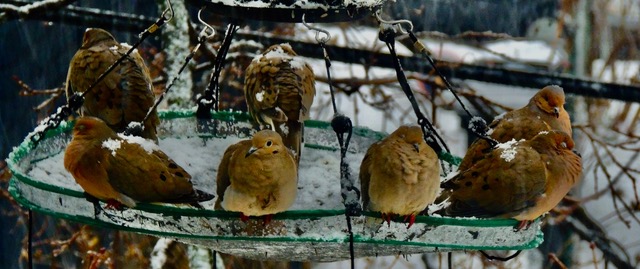
At first glance, the ring off our back porch may appear to be nothing but a humble seed catcher, basically a net to prevent errant sunflower seeds from dropping to the ground below. That happenstance is a problem insofar as it contributes greatly to the mess of shells left by the ground feeders in the yard, after they’ve consumed the fatty nutritious innards. By the end of winter this formidable collection of undigested bits must be cleaned up, a major chore. Another drawback is that those ground feeders, the doves and juncos and such, get the job done out of observation range of anybody in the kitchen, which greatly lowers the entertainment value for human observers like ourselves. We love providing sustenance for our fine feathered friends through the tough winter months, but we love watching them even more.

There would be no problem if avian diners (we’re talking to you, house sparrows) did not have such sloppy eating habits, constantly flipping perfectly intact undigested seeds earthwards in a steady stream, but sadly such is the case. For years we fed the birds sans net, but discovering the concept of seed catching and installing the device has revealed a whole new world of avian social relations. Up to that moment, one couldn’t help but notice how individuals and flocks of different species would come and go from the wire cylinder full of seed: cardinals and titmice, house finches and bluejays would all take their turns at the perches and narrow tray at the bottom, while the dominant species was the house sparrow, which vastly outnumbered everybody else. There was also the occasional squirrel, though never at the nuisance level that has discouraged many a hopeful bird feeding operator elsewhere. Adding the seed catcher, basically a three foot circular grazing area in the sky, brought onboard the birds we’d been feeding all along down below in the yard. Now the entire local avian social order fed in plain view, just outside our kitchen window.

And what manner of dynamic did we observe? Sporadic clashes of will and power, occasional drama and spectacle – it was a ring, after all – but so low key as to be almost polite. A kind of civility reigned, nobody winning and losing so much as giving way when the occasion demanded, only to return later on at a more opportune moment. In the course of a day everybody would eat by turns, but the timing had to be right. The whole show resembled a stage play more than a single competitive event, and of course it went on for hours, all day every day. This was not about glory or winning a bet or somebody’s notion of metaphysics, but something far simpler. Call it survival.
Or call it peace and harmony if that notion enchants you, but let’s not get carried away, either.
The fascination lies in who has power over whom in the moment. In pre-seed-catcher days, the house sparrows sort of ruled the roost, mostly by sheer force of numbers. In the sparrows’ favor there was also force of will and orneriness, traits which have long made them something to be reckoned with in the natural world, as well as an object of ridicule. Nobody likes a bully. As it goes with homo sapiens sparring in their square boxing ring, this ring has its own weight classes, which in the end can be telling. The house sparrow at 28 grams cannot hope to outcompete the gray squirrel at a whopping 500g, even with vastly superior numbers. The only backyard bird that can compare is the Cooper’s hawk at 450g, but appearances of that raptor have been so rare through the years as to be inconsequential. Still, wouldn’t it be something to see a Coop take on the fat gray rodent, an Iffley Road Rumble in the Skyjungle? Dream on!

In the real world of feeder relations, what looks like random and compulsive behavior in the moment can often be explained by the simple fact that weight matters. Lightweights like the diminutive chickadee (11g), nuthatch (27g) and tufted titmouse (21g) make all too brief appearances in the ring before absconding with seeds to a nearby tree trunk or branch, where they crack them open. The cardinal, more of a welterweight at 45g, will at times hang in there against the house sparrow’s numbers, but when it’s one-on-one against a heavier adversary like a grackle, a middleweight at 115g, it’s no contest. A bluejay at 85g will sometimes take on a grackle, making a dreadful racket all the while, but bluejays only show up singly or in twos and threes; in the end grackles rule, and they do so silently, which gets a bit unnerving.

Speaking of grackles, it’s always quite an event those several times a year when they show up 40 and 50 at a time, dominating not just the feeder but all the space out back, such is the power of numbers. Grackles are sheer visual pleasure, striking with their bone china eyes staring out at you from feathery intense blackness, or oily iridescence if it’s breeding season and the sun is shining. In the same weight class at 120g are the mourning doves, ground feeders who thoroughly adapted to the round grazing-space-in-the-sky from the moment it was introduced. Save for sporadic moments of gracklemania, it’s been all doves all the time for years, or at least doves below and sparrows above. To the doves’ credit, their territorial inclinations cease when the flock has eaten its fill, at which point they retreat to the nearby trees. There they take on the role of a silent audience for whatever conspires below, often until dark. Peace and harmony, amen.

Feeding seasons come and go, with no two ever quite the same. This past winter saw the appearance of two squirrels at once, for the first time ever (which did not become a trend, thank goodness), and our first northern flicker, going for suet. The suet cage is a smallish feeding venue, not round but square, a contested space at times but nothing like the ring above. Those tempted to make an analogy to the current human wrestling cage match spectacle should keep in mind that in our backyard no bird ever actually enters the cage, which is stuffed with suet. A cage stuffed with suet, of the size used by human wrestlers, would certainly present a spectacle all by itself, and might also smell pretty bad on a hot day. Such an outlandish development might seem a bit extreme, if not totally ridiculous, but then again have you ever watched cage match wrestling?

Speaking of spectacles, let us consider the pigeon. Boston is no different from any city in the world when it comes to pigeons,as in they’re everywhere, numbering in the thousands or possibly millions or at any rate huge numbers in the metro area. Pigeons come in a broad range of great colors, some of them iridescent, and provide excellent fodder for peregrine falcons, who nab them on the wing and eat them on rooftops. The domestic pigeon, aka sky rat if you’re one of their many detractors, is the all too successful descendant of the feral rock dove. It is telling that the average rock dove weighs in at around 270g, while their domestic counterparts run a beefy 300-400g, a testimony to omnivorous appetites and profound scavenging abilities. It also says something about the considerable food waste spread about the streets and dumpsters wherever homo sapiens dwell in any density.

The local neighborhood has its own population of Columba livia domestica, as one might expect. One can observe any number of them atop the old Franklin Brewery building at the bottom of our street, at least when there are no red-tailed hawks about. It’s an especially great roosting place in the winter, where a cold pigeon can join the flock up there to warm up with the first rays of the rising sun. Pigeons are also ubiquitous down on the street, often as not fighting over pizza crusts and hamburger buns and discarded empanadas when the opportunity presents itself, true survivors that they are.

What is germane to this discussion is the fact that until this past winter, no pigeon was ever observed going after the sunflower seeds on our back porch. In retrospect this is more than a bit curious, given that pigeons are such a force to be reckoned with in any big city, Boston being no different from the rest. St Mark’s square in Venice was world famous for its vast clouds of pigeons swirling about romantically at sunset, like a scene from a movie, but so many of the darn things in such concentrations can lead to a kind of squalor. Feeding them there is now forbidden, subject to a fine. Our backyard might attain a romantic aspect at times, but pigeons have never been a feature of this. There was no romance, at all, when they finally showed up at our feeder this past November, in what was essentially a coup, for lack of a better word.

Hostile takeover might better describe it, and it made for a feeding season like none other up to now. One day they simply arrived, in a frenzy of flash and motion, the ones below filling the ring to bursting and those above flapping frantically, as their bulk made it difficult to manage the tiny perches designed for birds of much smaller stature. A look around would reveal rows of others lined up on the roof next door or along the porch supports directly adjacent to the ring, moving in and out in a manner reminiscent of a wrestling tag team. The only birds who attempted to withstand this onslaught were a few stalwart mourning doves, previous rulers of the roost but who were now outweighed and outnumbered in spades. Is it possible for a bird to be dumbfounded?

As has been mentioned, the doves’ dominance had been measured, almost to the point of being polte. Compared to pigeons, they were smaller birds with smaller appetites. When the doves as a group were done feeding, there was always ample seed remaining. The pigeons were a different story altogether: they’d swarm about in the ring below until there was nothing left, as if a vacuum had passed through. Thank God struggles with the perches above limited their efficiency to the point where they had little effect, and the seed supply held. It was only for this that the past season maintained any level of normalcy, a bit of peace and harmony prevailing over the shock of pigeonpalooza. Or was it more like pigeongeddon? Apigeonpocalypse Now?

So spring has now arrived, and the winter feeding season is over. All that’s left is the last cake of suet, hanging there all by its lonesome, a humble cage-match venue that still draws a wonderful variety of birds, none of them pigeons, who’ll keep at it until it’s all gone. Come this November, the whole enterprise will crank up again and nature will take its course. Odds are the pigeons will be back; the doves might not even bother, which would be a shame, but that’s only from this human observer’s ultimately clueless perspective.

The fact is, a balance will be struck in one way or another, and the mourning doves will definitely not go hungry. The ring hanging over our backyard every winter is ultimately inconsequential in the grand scheme of nature, a story much larger than any one book could ever try to tell, so one needn’t go looking for it on Amazon. Better to look out the kitchen window at opportune moments in the proper season, or better still, just get out of the house and pay attention to what’s around you, as nature is always waiting, and you won’t need a credit card to sample it.
