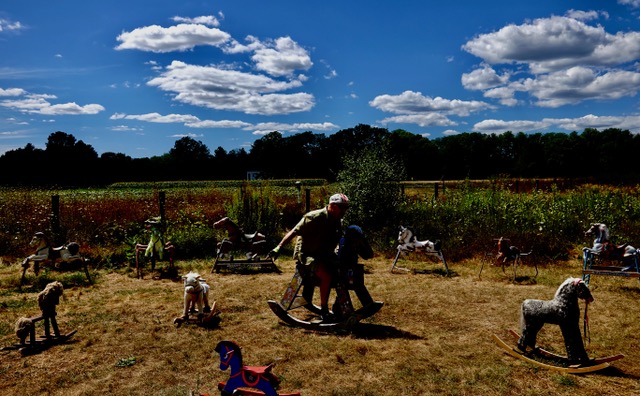
Life is all about change, of course, which you can embrace or resent or attempt to deny, or all three at various times, but in the end face it we’re stuck with it. Trying to comprehend change in a philosophical or Big Picture sense can be a bit daunting or even a pointless waste of time for the average person, but everybody can tell you about change in the context of their own life, where it can be endlessly fascinating, especially to themselves, and I say that with all due respect.

Change in one’s life happens in any number of contexts: relationships and work and self-expression and financial circumstances and all that, but as each year passes, if one is fortunate enough to live to see that happen enough times, the most consequential context of all becomes that of health and how’s that working for ya, anyway? We’re talking aging, getting old and noticing how you’re starting to wear out, so to speak, and I don’t mean for that to sound flippant or harsh. For some, of course, aging can mean catastrophic health failure that changes a life drastically or even ends it, but one always hopes that it all plays out in a more gradual and mundane fashion.

For those among us fortunate enough to grow older in this way, it tends to include a general and usually vague sense of loss, a certainty we can’t do things we once could, or at least not perform at the same level. We become aware that we walk slower or now take it easy doing stairs, and maybe our sense of balance is a bit more compromised and of course memory becomes slower and less reliable and aches and pains are a whole new ballgame. Your aging dog or cat walks around more stiffly and sleeps a lot more, a development memorably summed up by Robert Frost in the aptly titled poem The Span of Life: “The old dog barks backwards without getting up./ I can remember when he was a pup.” It is not at all clear dogs and cats are bothered by these changes, but of course this is not the case for many or most thought-burdened homo sapiens. There’s tons of professional and self-help advice and “spiritual” resources out there to help one accept and tolerate these changes, and if you’ve been struggling I hope you find the help you need. This essay is not going there.

The topic at hand here is more about measuring loss, not perceiving it as the steady but vague decline that it is, but having a more specific sense of what those changes have actually amounted to, as loss has progressed. Call it a more scientific approach, though it is hardly that. We all get little (or sometimes big) reminders of loss, here and there. What struck me recently is how this takes on its own qualities for anyone who has practiced a particular physical activity in a focused way, on a regular basis, for a long time.

This can encompass any number of activities, most of which generally fall under the category of “sport”, and a quick look around this website will tell you that for me it’s all about getting on a bicycle and riding it somewhere. Walking obviously has its charms, especially in winter when biking can involve a bit too much suffering, not to mention danger. And some places, with the serenity they offer, can only be experienced on foot, to state the obvious. But besides walking (and skipping and running and ambling) I assume all or most of us or especially you have spent time on a bike at some point in your life. It’s a required childhood activity in much of the world, and if you missed out you have my condolences. But in my own case it’s been an activity and a passion and close to a daily habit for most of 70 years, which I think you’ll agree is somewhat peculiar and remarkable and no doubt inscrutable to most people, including myself at times, if you can believe that.


Let’s just say that pursuing an interest at this level gives one what might be called a “long” or even “really long” perspective on how it once was and how it is now and even thoughts about what went on in between. Certain experiences can highlight this, and I present for your consideration the Pony Ride, so called because of a scenic highlight found along its route. It is also the Weston Ride, because it starts from the common in that leafy suburb’s town center. It’s also the Sudbury River Valley Ride, not to be confused with the Charles River Valley Ride that starts in Dover, a place much like Weston (for one thing, Dover and Weston are rated at #s one and two by most measures of local suburban wealth, which in the Boston metro area means wealthy, indeed). The ride is comprised of a number of carefully curated roads, as are all the rides we’ve been doing for about 40 years, which is how long I’ve lived in the Boston area. New England, with its long history of roadbuilding, might offer the most comprehensive network of quiet byways to be found anywhere, even near its major cities. Most Sunday afternoons in our lives have long been devoted to “out-of-town” rides beyond our local neighborhood, which suggests they might be a religious activity of a sort, and I will not claim otherwise. Though Sunday is not the day of rest that it once was, it is still the day when the roads are the quietest, at least away from shopping districts and larger population centers. Weston is wonderfully dead on Sundays, especially after the churches have let out. So’s Dover.


So it happened that Joan and I did this ride a few weeks ago, just the two of us, when no one else from our riding “group” was able to show up. Maybe it was this circumstance, or maybe what I ate for breakfast, that made me kind of all thoughtful and reflective, for a change. Lordy, do we know these roads! The Pony Ride is especially favored, insofar as Weston is only about ten miles from Jamaica Plain, the closest of our Sunday routes. The ride itself, like most of them, is about 25 miles long, which has been the “ideal” distance for many years, and I should mention that we drive to the start, which gets us to one of those Measures of Change. In the Beginning, long long ago (which in this case is 30-40 years) we’d start from the house and ride our trusty steeds out from the city to music events and car shows and food fairs in these same ‘burbs, then home again, which was easily 40 miles or longer. Even crazier, in the Wild Frenzy of Youthful Energy department, once a week in the summer I’d ride at 6am to the bike shop in Cambridge where I worked, do a ride with colleagues – on these same roads – then work an eight hour day and ride home. It was joyous.


As we started our recent ride to the ponies I thought about these things. The energy nowadays is still there, though the body responds in a much different way to the road’s demands. We’re slower and we know it. This old biker has a specific measure of this, and some sharp memories. In the olden times, when he was thinner with more muscle mass and better lungs, he rode a whole lot, and sometimes with a local fanatical club, the Charles River Wheelmen. You may see club riders on your own local roads sometimes, usually in large groups and colorfully dressed in inscrutable European team jerseys and hogging whole lanes of busy roads. This is because it’s easier to go faster with large groups in such an environment, even though the downside is you mix with the cars whose drivers tend to find you obnoxious. It helps to be arrogant. Anyway I have this memory of doing a ride whereby we covered 51 hilly miles in three hours. It struck me as funny that 51 was perfectly divisible by three, which meant 17mph. I’ve always remembered it as no doubt a personal best, because riding with a group like that means you draft one another and egg each other on up the hills and it’s a celebration of youth and power and the efficiency of the bicycle. Call it Masochistic Joy.


Speaking of personal bests: there was the time I celebrated completing my two years of alternative service for the US govt (remember draft boards? the lottery? the Vietnam War? yeah it was a long time ago). I got on a bike with a tube tent and a rain poncho and rode from Chicago to Boston. It took about eight days. I was 22 years old. About eight years later I met Joan who was the perfect riding partner and there were the times the two of us loaded our bikes with camping gear and did something similar: Boston to Burlington VT, Boston to upstate NY and Joan’s home town, Boston to Cape Breton. Then there were the two weeks riding all over western Ireland, visiting old ladies running bed & breakfasts serving the same meal of eggs and sausage and a slice of tomato and limitless amounts of brown bread. We’d spend the whole day burning it off, pure joy. There were lots of hills and I won’t say they were nothing but we never had a doubt that any would stop us or even get in the way of our good times. Maybe it was the challenge of the thing that made it easy, or at least possible. Don’t we all love a challenge? At least when we’re young?


Sometimes the thought strikes me: Was that really us? Did we really do those things? And if not, who were those people? Is this what aging is all about? Nostalgia is supposed to be about warm and fuzzy memories, but can bewilderment also be found in the mix sometimes?


But here it is, many years later, and the two of us will ride from Weston common a few miles down the brand new Mass Central Rail Trail, which wasn’t even part of this ride until a few years ago, then along the mighty Sudbury River for a ways, where we’ll have a nice meal at a restaurant. From there we’ll ride most of the same old Sudbury Valley roads we always have, with a few of the hills now edited out, though by no means all. We’re not that old, at least not yet. We’ll head down Water Row (that’s the name of the road!) through the Great Meadows National Wildlife Refuge and cross the river on Sherman Bridge Road, where the wooden bridge has been rebuilt at least once in our memory and today desperately needs another rebuilding, as the wood has warped to the point where it’s tricky to ride it on a bike. Then we’ll pass by the ponies, travel up past the Codman Farms and Estate, and do the long climb up Baker Bridge Road past the Gropius House, which has long been a landmark on this ride (the climb and the house both). We’ll ascend really slowly and it might get hard to breathe and even hurt a little, but might this not still be joyful? In fact the whole experience, which usually takes three to four hours, is always a delight in one way or another, though it’s different than it once was. We will average about 10mph and take pride in pulling that off.


On our Sunday rides with our current riding group, which I pretend is a biker “club” affectionately named the Outlaws, the two of us are the oldest by a number of years, though all of us but one are well past 50. When we ride we tend to see lots of solitary riders and couples and small groups, dressed in the ever fashionable shiny colorful biker garb, and many look intensely serious, probably staring at their computers and working hard to get better data for their training regimens. Most are men. They are almost all much younger than we, and of course they tend to roar past us, especially going uphill. We were all young once, and we smile at them. Do they notice?


I was them once, pedaling in the city and elsewhere. I was accustomed to roaring or at least cruising past almost everybody but the most hardcore racer-types. I did the miles, practiced good form, worked at it and found that it all paid off in efficiency. For many years I could still easily pass casual riders much younger than myself, especially in the city. They were not as serious about it or as fit as I was, at least on a bike. Then time passed and that all changed, most acutely in the last ten years or so. Younger people older people people who look “out of shape” people on really clunky bikes like those ride share Bluebikes nowadays cruise past me, and I smile. At one time it felt kind of humiliating, then was just sort of humbling, and then at some point I got to admire what great riders all of these people are, loving the ride as much as I did. It must be that acceptance thing chatted up in the self-help books. Part of the acceptance process is that you have no choice anyway when it comes to How Things Are, so why fight it? “Resistance is futile”, as the Borg remind us, and they’re right, at least about some things.


So nowadays the thought arises about How Long Can We Keep This Up and Where Might It All End? Nowadays there are these organized bike groups, mostly elderly, who stick to the rail trails, which are pretty flat and obviously free of the danger of motorists. A few of our Sunday routes incorporate sections of these straight narrow byways into parts of the road network. The allure of most rail trails is that they’re free of the dangers of the automobile, but aside from that most provide way too much monotony for someone who’s always loved the diversity of shifting terrain and scenic views to be found on a roadway. On a flat ride one never rests, unlike the uphill efforts and downhill breaks that ups and downs offer. A ride on flat terrain is physically difficult in its own way, as strange as that might sound. And the narrowness and mix of walkers and kids and babies in strollers and rollerbladers and such on the car-free rail trail has always made them less appealing and fraught with their own kind of danger and demands for one’s attention, at least to this lover of roads, though rail trail fanatics are legion. It takes all kinds to make a bikable world.


But might it all be leading to some kind of inexorable progression for the aging cyclist? From the hilly roads to the flatter roads and then to the rail trail, and finally to the stationary bike in the family room or down in the basement? Is that how it all ends, my friend? My secret plan is to at keep it up as the Old Guy Who Rides Around the Neighborhood, at least forever if not longer. I’ll tell you how it goes, or maybe you’ll just see me riding along the sidewalk some time, and you’ll smile. In fact there’s a strong chance that I’m that guy already, kidding nobody but myself about the inevitable.


